ZENO LEONI
King’s College London, England
VERONICA STRINA
Università per Stranieri di Perugia, Italy
Abstract: The War in Ukraine has had international order implications, deepening previously existing fault lines between West and East (Leoni & Tzinieris, 2024). As China’s grand strategy does also have an impact on the international order, the conflict in Eastern Europe provides an opportunity to pause and reflect on what this means from a perspective of China’s engagement with the world. While the literature on Chinese grand strategy has been prolific in recent years, lessons from Ukraine have yet to be captured in a systematic manner.
Hence, this article examines China’s behaviour in relation to the war in Ukraine to evaluate whether this case study offers valuable insights into China’s grand strategy and foreign policy.
The contribution concludes that the war in Ukraine has confirmed that China is not yet willing or capable of taking a role of leadership over international controversies, and thus is not directly challenging US hegemony. However, it is actively seeking to build a sphere of interests that involves non-Western countries and the developing world, as highlighted by our discourse analysis of the communications on the “Ukraine issue” from the Foreign Ministry through its spokespersons.
To assess whether there is evidence that the war in Ukraine has provided China with an opportunity to pursue a hegemonic project and whether it has been successful at it so far, the article adopts a critical IR approach and delves into the study of communications by the Chinese Foreign Ministry spokespeople on the “Ukraine issue” as key to building a hegemonic discourse. Articles published from the 24th of February 2022 until the 24th of February 2024 have been extracted from the official website of the Ministry of Foreign Affairs of the People’s Republic of China and imported into software for qualitative and mixed methods data analysis to examine keywords’ frequency and correlations.
Keywords: Chinese grand strategy; Ukraine war; Hegemony; Olympics; Hegemonic discourse.
Para citar este artículo/to cite this article: Zeno Leoni & Veronica Strina, <<China: New Hegemonic Power after the War in Ukraine?>>, Revista de Estudios en Seguridad Internacional, Vol. 10, No. 1, (2024), pp. 69-88. DOI: http://dx.doi.org.10.18847/1.19.5
Chinese grand strategy
Grand strategy is usually defined with an emphasis on its three components, which are ends, ways, and means. John Lewis Gaddis describes it as an “integrated and coherent set of ideas about a state’s ultimate objectives in the international system, and how it should go about achieving them” (Gaddis, 2018: 21). Some recent interventions, furthermore, put the emphasis on the long term direction of travel of a country’s foreign policy. Indeed, there is who stated that the concept of grand strategy contains “an overarching and enduring vision to advance the national interest” (Scobell & Feng, 2009). Similarly, there is who sees grand strategy as synonym with the “intellectual architecture that lends structure to foreign policy” (Brands, 2014: 1). Others even go as far as linking grand strategy to “vital ends” (Biscop, 2021: 3).
With regard to China, the debate has considered whether Beijing has a grand strategy (Buzan, 2014: 381-382). In the words of Wang Jisi, this is because while China has been “remarkably consistent” in its foreign policy, “the Chinese government has yet to disclose any document that comprehensively expounds the country’s strategic goals and the ways to achieve them” (Wang, 2012: 68). At the same time, recent contributions were keen to define Chinese grand strategy, at times more strictly at times more loosely, follows this framework with key arguments tending to follow the above-mentioned definitions of grand strategy.
According to David Denoon, “China intends to become the preeminent global power and has set a target date of 2049 for achieving that goal (Denoon, 2021: 233). Denoon adds that to achieve this objective, “the Chinese leadership does not think war is necessary” (ivi). Jean Kachiga finds a Chinese grand strategy in the fact that China has “the political will … clear objectives … resources and means, and…is driven by ambition to reach the top, where it thinks it belongs” (Kachiga, 2022: 33). Rush Doshi maintained that China has been on a “long march” to displace US hegemony with progressively growing intensity through three steps – “blunt”, “build”, and “global expansion” (Doshi, 2021: 3–4, 10). It was argued that the driver of China’s grand strategy lies in the fact that the country “has been disunited often”, and this has had an impact on every Chinese leader from Mao to Xi; China has had “little experience of conducting foreign policy as a unified, secure entity. That inexperience has been the hallmark of PRC grand strategy” (Khan 2022: 4). Avery Goldstein maintained that since 1949 China has had two grand strategies, that is “one focused primarily on coping with existential threats to the regime’s survival, the other focused primarily on regaining China’s standing as an advanced country and great power” (Goldstein, 2020: 168).
Contributing to this literature, the article identifies these two as the main drivers of Chinese grand strategy and reflects on the implications of the dialectical relations between them. In doing so, the approach to Chinese grand strategy presented in this paper also aligns with the above discussion on definitions of grand strategy, in so far as it places emphasis on China’s long term objectives.
To understand modern Chinese grand strategy, one must consider the watershed of the First Opium War (4 Sept 1839–29 Aug 1842), when China was defeated by Britain. This event was a shock for the imperial dynasty of the time because Western imperialism “destroyed” China’s “self-image” of a “culturally superior civilization”, making the “reversal of power” and need for modernization evident (Heilmann 2017: 23; Mitter 2008: 10, 82). The pursuit of modernization in a competitive and West-led international order has been a constant in Chinese grand strategy since then. The friction between these two interests lies at the heart of it (Leoni, 2023: ch. 2).
Due to the challenges faced during the Century of Humiliation and how fast China has been changing in the decades after that – that is, since Mao Zedong’s rise to power in 1949 – Chinese grand strategy has been evolving, and it remains in a period of gestation (Leoni, 2024: ch. 3). While during the years of Mao Zedong China did not catch up with the West economically, this experience was key in delivering to the country a strong polity with stable borders, essential prerequisites for any grand strategy to develop (Scobell et al., 2020: 14). It was only when Deng Xiaoping rose to power that China “returned” to the 19th-century idea of “making China rich and powerful” with the ‘Four Modernizations’ (si ge xiandaihua四个现代化) (Garver, 2016: 349). Eventually, Japan and the Four Tigers in Asia – Hong Kong, Singapore, South Korea, and Taiwan – provided a leading example (Garver, 2016: 368). China needed to build a safe environment around its perimeter to achieve such modernization (Khan, 2018: 3). For this reason, most of its foreign policy after 1978 was “focused on facilitating … economic development”, and in particular on the “reduction of the high levels of tension that existed in China’s relations with nearly all the Asian powers” (Norris, 2016: 44; Garver, 2016: 428).
Considering this, Chinese grand strategy was underpinned by an acknowledgment that the PRC was “poor and weak”, and that it would have taken a “very long time” for this to change (Garver, 2016: 429).[1] For this reason, Beijing was maintaining a profile “commensurate with its growing economic strength” (Chang Liao, 2018: 87). But to an extent, there was an “evolutionary shift” after the Great Recession (2008), as China, rather than using its foreign policy to achieve economic objectives, started to do the opposite, that is, pursuing political objectives through economic means (Norris, 2016: 44). In this regard, others saw a “year of assertiveness” in Chinese foreign policy happening as early as 2009-2010 (Shambaugh, 2020: 16).
With Xi Jinping emphasizing the spirit of “strive for achievements”, this begs the question of whether China’s “humility” and “cooperative” spirit disappeared in the new era, or whether this is in continuity with that of his predecessors (Garver, 2016: 429; Goldstein, 2020: 164; Chang-Liao, 2018: 83). For instance, RAND saw the post-2004 era as one “rejuvenation” (Scobell et al., 2020: 12). But others countered that Xi’s foreign policy is not in contradictions to Chinese grand strategy, to the extent that this continues to aim to “reassure”, “reform”, and “resist” (Goldstein, 2020: 164).
The key to this debate is where the emphasis on the definition of grand strategy is put. If one was to highlight the role of “ways” and the “means”, change might be more evident over continuity (van Hooft, 2017). However, if one was to emphasize the “ends”, continuity with Chinese grand strategy becomes more evident. While Chinese grand strategy has adapted to changes to its national power and to the international strategic environment, it has not shifted from its original objective (Swaine & Tellis 2000, x).
An assessment of “ways” and “means” is also relevant to this study. For Chinese strategy makers, the country continues to suffer from structural weaknesses. This is one key takeaway from the Constitution of the Chinese Communist Party, where it is acknowledged that “China is in the primary stage of socialism and will remain so for a long time to come” (Permanent mission of the People’s Republic of China to the United Nations and other international organizations in Vienna, 2012).
Considering this, scholars argued that there are “mixed signals coming out of China over the last decade”, with signs of acting both as a ‘peripheral country’ and a country that has a “desire to assert its leadership” (Danner, 2018: 1). Others framed this by looking at China as a “weak-strong” power, that is, one which operates with a “calculative” and which has a “non-ideological” approach to political economy; a “restraint in the use of force” sided by military modernization; and it shows an increasing “involvement in regional and global interstate politics” (Swaine & Tellis, 2000: xi).
This is coherent with the argument that China “has the potential to become a world power” but it is not there yet due to several reasons, including the Taiwan issue, an ongoing low GDP per capita, low “scientific and technological creativity” and limited “international influence” (Ye, 2022: 3).
China, therefore, is not aiming at disrupting the liberal order; at the same time, it does not hide its “reluctance to exercise power in pursuit of its own agenda” (White, 2013: 45–46). To an extent, this can be explained not only through the lenses of the tension between modernisation and lack of trust in the international system, but also by considering Chinese strategic culture as a product of ideas of both Sun Tzu and Marxism. Ultimately, this implies that the objective world – “the reality one faces” – frames the subjective thoughts, which represent the “policy makers” or commanders’ ability to utilize, influence, or manipulate these objective factors for their benefits (Thomas, 2014: 13–14). If the objective base is about taking into account the “comprehensive national power”, the subjective would use “stratagems” to exploit that power – or the adversary’s weaknesses – and “gain superiority” (Thomas, 2014: 15; Jullien, 2004: xii).
Balancing competing interest in foreign policy
China’s engagement with the international order, and its quest for alliances and leadership, is characterised by different types of frictions unfolding at a lower level of analysis, that of foreign policy.
The invasion of Ukraine, in particular, has brought to the fore tensions between China’s respect for “territorial sovereignty” and for “non-interference” (Zheng, 2014: 349-350). On the one hand, China could not fail to see in the war of Ukraine the violation of a sovereign country. On the other hand, China’s respect for “non-interference” prevents Beijing from seeking to influence Russia, especially since it is clear that from a Russian perspective Ukraine represents a domestic matter, as much as China sees Taiwan as an internal issue.
While during the first weeks of the campaign Foreign Minister Wang Yi suggested that a middle ground could still be found to respect Ukraine’s sovereignty and accommodate Russia’s security, China abstained during two votes about the current crisis, one from within the Security Council and one at the General Assembly. Ultimately, China has not joined the West in sanctioning Russia – as many hoped. This was the one action that would have tilted the balance of forces in favour of Ukraine and the West, causing not little trouble to Moscow. On the contrary, Beijing has continued to blame NATO and the West for waging wars around the world (Tian, 2022).
China is not on the lookout for friends among the core states of the European Union – despite it makes sounding billion with those countries – or the US, because Beijing knows that for the foreseeable future it will not be able to gain political and diplomatic concessions – at a time when the US is seeking to contain China. To be fair, there is agreement – and rightly so – in positing that trade with the West remains very important for China. According to Westad (2022), “its relationship with the United States and with Europe will always be more important than relations with Russia”. Others added that “China has generally refused to sell arms to Russia and to circumvent sanctions on Moscow’s behalf because preserving global market access is more important to Beijing than any economic link to Russia” (Feigenbaum & Szubin, 2023). However, China has clearly not sided with the West in condemning Russia, but it has instead showcased on a global stage its partnership with Moscow. As Colonel Zhou Bo effectively summarized (2022), “[i]f the enemy of my enemy is my friend, is the enemy of my friend also my enemy? Not necessarily. Or so China’s thinking goes when it comes to the raging Russian-Ukranian war”. He added that if China was to support the West, it would be “only a matter of time before America takes on China again” (Zhou, 2022).[2]
While prioritizing political as opposed to economic interests reflects an attitude that one might describe as very Chinese – albeit, that of a “hundred-year marathon” seems a superficial caricature – there is more to it (Pillsbury, 2015). If one looks at the United States, for instance, it is fair to ask what would it be of the American hegemony if it was not for the network of alliances that helped Washington, D.C. project influence quasi-globally? Without Germany and Italy in Europe, Saudi Arabia and Bahrein in the Gulf, and Australia and Japan in the Pacific, the United States would probably be a local power in the Western hemisphere (Cha, 2016; Leoni, 2021: 64-77). In other words, China is currently going through a historical stage of its grand strategic trajectory where it must make political “friends” if it wants to continue its positive growth, and this may be more important than short-term, direct economic interests.[3] These friends – more partners than allies – are crucial if China wants to project its influence beyond South-East Asia and Central Asia; shape multilateral institutions from the inside to change the rules of international regimes and standards; and start building the basis for developing forward military capabilities (Leoni, 2023: 49).
The types of friends that China will need to build a sphere of interests – as Beijing seems far from being capable of ruling over it – however, at this particular historical junction can only be found in the developing world and among all those states that have not wanted to sanction Russia (Spektor, 2023). For the time being, EU members will continue to argue against China on a political level, and there is little China can do to please them; at the same time, Beijing is confident that these will not dear to impose secondary sanctions on China because they need access to its market. It is not to be discounted, however, that the recent EU agreement to impose sanctions on Chinese and Indian companies with ties to the conflict in Ukraine may undermine this confidence. But at present, Beijing can support Russia without facing significant repercussions as long as its support remains subthreshold (Zhang, 2024: 4).
While about the war in Ukraine China has fundamentally accepted that Russia is keen to continue to wage war until military or strategic objectives are achieved, and did this with a political mindset, in other countries it has behaved in a similar way. In Myanmar, China accepted a military coup and the subsequent Tatmadaw junta because the alternative to it might have been greater instability despite Beijing preferred the toppled government of Aung San Suu Kyi (Stranjio, 2021). Similarly, China for years saw in North Korea an inconvenient partner, but ensuring regime stability has been a core interest for Chinese elites. North Korea is not an easy friend for China, because “Beijing’s biggest dilemma is to prop up a regime it does not like at all” (You, 2011: 27). However, stability is key for the Chinese leadership, therefore tolerating it is necessary for a greater good. Furthermore, the level of influence that China has on Pyongyang is overstated, similar to how overstated during the initial phase of the war in Ukraine has been the influence of China over Russia. The deduction is that opposing Russia more confrontationally in Ukraine might achieve a more destabilizing effect than letting the more powerful military side follow its objectives.
Lesson from the olympics and Russian invasions
China’s ambivalent behaviour in the context of the Ukraine war confirms that Chinese grand strategy faces a dilemma between anxiety about a west-led international order and the need to engage with the west for China to continue to pursue its modernization goals. This tension, which has been tangible since the First Opium War, remains a dilemma nowadays and can be readably detected in the context of mega-sport events, particularly at the Olympic Games hosted by China in 2008 and 2022, and at the Sochi Games in 2014.
Borrowing from Key’s words (2009), political events that precede, follow, or occur during the Olympic Games provide evidence that sport, far from being a “mere mirror” of international politics, can be a “transformative influence” and a “magnifying glass” of global politics. This holds true especially if one considers the nexus between the Olympics held both in the Russian Federation and the PRC and the consequent military actions conducted by Russia. It points indeed to a compelling pattern: Moscow’s invasion of Georgia in 2008 took place during the Summer Olympics in Beijing; the Kremlin’s annexation of Crimea occurred during the 2014 Olympics in Sochi; finally, the Russian invasion of Ukraine happened shortly after the 2022 Beijing Winter Olympics. These events underscore the significance of the sports arena in capturing the complex puzzle of China’s positioning in the Ukraine war along with Beijing’s evolving posture towards the West-led international order.
Far from showing subthreshold support for Putin’s intentions, the dawn of the Beijing Winter Olympics heralded the advent of a “new era of International Relations”, proclaiming to the world the “no-limits friendship” void of “forbidden areas of cooperation” between Russia and the PRC (President of Russia, 2022). Given the elevated stature of the Sino-Russian strategic comprehensive partnership as “superior to political and military alliances of the Cold War era” (ibid.), the mega-sport event has been decoded as China’s “tacit endorsement of Putin’s war” (Wu, 2023). The developments in the Sino-Russian relationship following the Beijing Winter Games, however, have also brought to light the limits inherent to such “no-limits” friendship. Above all, is the Kremlin’s revisionist strategy which risks undermining the Chinese imperative for “stability” (wending 稳定) – fundamental for the realization of the Chinese dream of national rejuvenation. Furthermore, Russia’s assertions come at the cost of Beijing’s endeavours to uphold its “reputation” (mianzi 面子), and in particular its national image as a “responsible power” (fuzeren daguo 负责任大国). A clear example is the call – albeit promptly censored – from some renowned Chinese historians who condemned the Russian large-scale invasion in February 2022 against “a significantly weaker sister country” (France Mèdias Monde, 2022). All in all, Russia’s military intervention in Ukraine posed considerable diplomatic and reputational challenges for the Chinese government.
Nonetheless, as our analysis of Chinese official discourse on the Ukraine war has revealed, communications from the Chinese Foreign Ministry spokespeople have sustained neutrality while displaying a bias in favour of Russia – a trend that is also evident in the state media coverage (Repnikova, 2022). Indeed, as Repnikova argues, the Chinese narrative of the war has echoed and reinforced the Russian position while minimizing and under-reporting the Ukrainian perspective (ibid). In the last two decades, the “friendship” rhetoric has markedly characterized the Chinese official discourse on Sino-Russian relations, persisting – albeit extensively diluted – throughout the conflict and regaining momentum after Xi Jinping’s state visit to Russia in March 2023 – in Qin Gang’s words “a journey of friendship, cooperation and peace that attracts worldwide attention” (as it came just a few days after the International Criminal Court issued the arrest warrant for the President of Russia) (MFA PRC, 2023a). In 2019, Xi Jinping went as far as referring to Vladimir Putin as his «best friend» (BBC, 2019) and in 2021 – the year of the 20th anniversary of the signing of the China-Russia Treaty of Good-Neighborliness and Friendly Cooperation – the Chinese foreign minister Wang Yi pledged to stand “shoulder-by-shoulder” and work “back- to- back” with Moscow (MFA PRC, 2021a). This position was remarked on the eve of the invasion of Ukraine when the Sino-Russian relationship was presented as the example of safeguarding international justice and equity, “showing the world how a great nation should look like” (rang shijie kan dao daguo ying you de yangzi让世界看到大国应有的样子). (MND PRC, 2022). Such a pro-Russia narrative has revealed to be primarily functional to highlight the “sharp contrast to those closed, exclusive, selfish and narrow-minded bloc politics” (MFA PRC, 2023a) as well as their “old-fashioned thoughts, such as cold-war mentality, hegemony and power politics, which have long been swept into the trash bin of history, (and) are coming life again (…) hoping to regain momentum” (MFA PRC, 2021b).
From this perspective, the joint statement unveiled on the 4th of February 2022 in the context of the Beijing Winter Olympics represents the manifesto of the two States’ contestation of the US unilateral approach to addressing international issues, inaugurating what is termed as “Olympic diplomacy as contestation” (Diodato & Strina, 2023). The new era of this kind of sports diplomacy where contestation has emerged both as a norm and a tool of contemporary Olympic Diplomacy may elucidate the delicate balancing act that China navigates regarding the Ukraine issue. On one hand, it seeks to maintain positive relations with the West to advance its modernization goals and dilute the increasingly hostile external environment by assuring the international audience of its peaceful rise and its responsible stance. On the other hand, it pursues a political agenda that involves challenging the Western, US-led order with the crucial support of Russia as a “like-minded friend” while further aligning itself with the Global South.
Lessons from the 2014 Sochi Games and the 2008 Beijing Olympics
When on the 6th of February 2014 President Xi Jinping arrived at Sochi Adler Airport to attend the Olympic Games hosted by Russia, the Foreign Ministry Wang Yi described the event as “a Friendship Journey to Winter Olympics (that) Opens a New Chapter in Diplomacy”, expressing the embodiment of “China’s firm support for Russia hosting the Olympics” (Renmin Ribao, 2014). It was the first time for a head of state from China to attend the opening ceremony of a major international sports event abroad, making Russia “the first country visited by President Xi for two consecutive years” and proving once again “the high level and distinctiveness of China-Russia comprehensive strategic partnership” (ibid.). As argued by Wang Yi, the Sochi Games created a new model of a Chinese state leader to attend large-scale international sports events abroad and represented a platform to showcase China and Russia as responsible actors in maintaining international and regional security, for instance by participating in escorting the shipping of Syrian chemical weapons (while vetoing several UN resolutions attempting to impose sanctions on the Syrian Arab Republic).
Despite the significant efforts to boost its global status, Russia’s portrayal as a responsible actor was soon betrayed by the Kremlin’s actions in Crimea, which took place amidst the Olympic truce called during the Sochi Games (Grix & Kramareva, 2017). As soon as Putin looked East, China and Russia signed the biggest contract in the history of the gas sector, a 30-year deal worth $ 400 billion between Gazprom and China National Petroleum Corporation to build the “Power of Siberia” natural gas pipeline (Reuters, 2014). Despite China’s discomfort with its position as the “tiebreaker” between Russia and the West, Beijing showed itself as a willing partner (Ash Center for Democratic Governance and Innovation, 2022). The comparison with its present approach on the Power of Siberia 2 – which was announced by Putin in the autumn of 2022 to connect Russia’s gas to China via Mongolia serving as an alternative route for the Russian gas destined for Europe through Nord Stream – is readily evident. Compared to 2014, Beijing has deliberately slowed down the progress of discussions, employing a cautious «wait-and-see» approach while offering Russia a “get-out-of-jail-free card not to break their marriage of convenience” (Leoni, 2022).
Following the Sochi Games and the annexation of Crimea, the growth in energy and military cooperation (exemplified by China’s involvement in Russia’s Vostok-2018 strategic manoeuvres conducted in the Russian Far East) has paralleled a growing convergence in rhetoric and visions of world order. On many occasions, the two declared themselves to be allies when it comes to “defending international law” and affirming a rightful, democratic, and truly global world order (Lukin, 2021). This convergence was palpable at the 70th anniversary of the end of World War II, when Xi and Putin attended each other’s military parades appealing to build a new model of international relations with win-win cooperation as its core, refuting “the law of the jungle, warlike or hegemonic policies, the winner-take-all mindset and zero-sum game” (MFA PRC, 2015).
Since the Crimean crisis outbreak, China has shown support for Putin’s “legitimate concerns” to the extent they are functional to the erosion of the US-led rules-based international order, arguably China’s long-term political objective. Yet, it officially refused to take sides, as demonstrated by the PRC’s abstention on the 15th of March 2014 from voting for the UN Security Council resolution declaring the results of the Crimean referendum on reunification with Russia invalid. Rather than as a form of acquiescence toward Russian aspirations, however, this approach is the result of Beijing’s long-established non-interference principle. As Wishnick argues (2017), more than sincere friends, Beijing and Moscow are “partners of consequence” bound by a worldview affinity and intolerance toward the Western-led order, which makes them “friends in need” that, as Xi once said, “is friends indeed.” (China Daily, 2023a).
Likewise, China’s response to the Russian military intervention in Georgia at the opening of the Beijing 2008 Olympics was “to walk the line between maintaining a ‘strategic partnership’ with Russia and acting as a ‘responsible stakeholder’” (Zhu, 2008). The Games constituted an important milestone in bringing Sino-Russian relations to a new high and showing that “Russia totally support(ed) the Beijing Olympic Games (and) was the first to share the triumph of China in the difficult marathon to win the right to host the Olympics.”(Russian Government, 2008). It is therefore not surprising that, as noted by Dmitry Trenin (2008), China’s Foreign Ministry “took its time before issuing an essentially pointless statement”. Yet, in the aftermath of the Beijing Summer Olympics, in particular at the Shanghai Cooperation Organization summit held in August 2008 in Dushanbe, President Hu Jintao played a role in opposing Russian lobbying efforts to attain recognition for the independence of Abkhazia and South Ossetia (Wishnick, 2009). Not to endanger its proclaimed stance of creating a ‘‘harmonious world”, China’s reaction was to deliver neutrality and sophistication through its international responsible positioning (guoji zeren dingwei 国际责任定位) (Zhu, 2008).
When juxtaposing the current Chinese official discourse on the Ukraine war with that of 2008 and 2014, a compelling question emerges regarding whether China’s today diplomatic approach is “new wine in old bottles.” Beijing’s alleged neutrality – or rather its “pro-Russian neutrality” – is indeed a long game that aims to maximize the benefits from Russia’s support and its growing isolation while minimizing the negative fallout of this confrontation on its position as a responsible stakeholder and on its already strained relations with the West. The employment of terms such as “matter of Ukraine” (Wukelan shiqing 乌克兰事情), “crisis” (weiji 危机) or vocabularies typical of the Russian state media like “special military operations” (特别军事行动) instead of “invasion” (qinlüe 侵略) or “war” (zhanzheng 战争) is nothing new.
Since the Ukrainian conflict has unfolded, rather than a positional change, the Chinese leadership seems to have shifted the perception of Beijing’s international role as an increasing diriment in determining the future of the “hotspot issues” in the world (MFA PRC, 2023b). This new protagonism and confidence are exemplified by the release of China’s position paper on Ukraine one year after the Russian invasion and the inauguration of the Global Security Initiative during the 2022 Boao Forum – whose contours are elucidated by the Concept Paper (MFA PRC, 2023c) published concurrently with “China’s Position on the Political Settlement of the Ukraine Crisis” (MFA PRC, 2023d).
At the same time, China’s posture on the war in Ukraine shows that Beijing, despite its charm offensive with a tentative and generic peace plan, has not been key to playing the role of an influential mediator. On the one hand, China is not ready to take the lead from the viewpoint of military capabilities, nor from an ideological viewpoint. In the short-term, China is not going to act as an international arbiter of disputes among other states as the US has been doing for decades. However, China’s mediation of the Saudi-Iran deal might represent a new watershed, especially considering that a political East is taking shape. Should Beijing insist on mediating but hardly achieve a tangible outcome, this could represent a setback insofar as it would prove that China has limited leverage over its partners. Or that its diplomatic influence remains limited to its region or to small powers.
Lessons on China’s influence and hegemony: A discourse analysis of the PRC Ministry of Foreign Affairs’ Communications on the “Ukraine Issue”
In order to gauge the extent to which the Russian invasion has provided opportunities for the rise of Chinese hegemony and its implications on the formulation of Chinese grand strategy, the article examines whether the conflict has enabled Beijing to establish a hegemonic discourse under the guise of a “community for a shared future” and its purportedly “just and objective” stance on the “Ukrainian issue”. Indeed, discursive practices are crucial to consensus-building and the creation of a new “common sense”, which constitutes the premise for moving beyond what Guha (1998) names “dominance without hegemony”. Hegemony constitutes a key concept in IR theory and a lens that has been extensively used to decode the global power shifts and the US world power’s decline vis-à-vis China’s rise. Despite the different approaches to examining hegemony in world politics, there is a consensus on its understanding as a capacity for coercion and influence over the structures of the international system and the international behaviour of its units (Antoniades, 2018).
This article builds on Giovanni Arrighi’s (1994) interpretation of the Gramscian category of hegemony as the “moral direction” of social relations at the inter-state level, thus understanding “world hegemony” as the “additional power” that accrues to a dominant group in virtue of its capacity to put on a universal level its particular interest. In other words, global hegemony is intended here as grounded on the ability to lead the international system in one’s desired direction by presenting national interests as oriented towards the collective will (Arrighi, 1994). By adopting this lens, we decode the possibility of China as a hegemonic ascent in the Ukrainian conflict by questioning its ambition and capability to exert intellectual and moral leadership. From this perspective, we ask to what extent, in an age of global disorder which “looms large or larger in world politics than the element of order” (Bull, 2002: xxxii), the war in Ukraine has constituted a tool to advance China’s vision of the world and bolster Beijing’s discursive power at the international level, aiming to strengthen its global role as a “responsible major power” with the oldest living civilization.
The article develops a critical discourse analysis as informed by Norman Fairclough (1995) of the Foreign Ministry spokesperson’s remarks and press conferences reporting the word “Ukraine” in the titles published from the 24th February 2022 until February 2024, in two years’ time frame. Articles have been extracted from the official website of the Ministry of Foreign Affairs of the People’s Republic of China and imported into software for qualitative and mixed methods data analysis to measure keywords frequency and correlations.
Analyzing the statements of China’s Ministry of Foreign Affairs serves as a valuable entry point into understanding China’s foreign policy formulation, despite the complexities inherent in the country’s state structure and the presence of competing interests and agendas among different actors. While it is acknowledged that the Ministry of Foreign Affairs may not singularly represent China’s entire spectrum of interests and ambitions, it remains not only a significant actor in shaping and articulating the nation’s political agenda but also in broadcasting Beijing’s voice to the world. Since 2013, the Chinese leadership has indeed attached particular attention to the so-called “discourse power” or the “right to speak” (huayuquan 话语权), remarking on the importance of “tell China’s story well” (jiang hao zhongguo gushi 讲好中国故事) and building a storytelling that emphasizes Beijing’s willingness to share global responsibilities (gongdan quanti zeren 共但全体责任) and its commitment to building a “humanity with a shared future” (renlei mingyun gonggongti 人类命运公共 体). Therefore, examining the communications of the Chinese Foreign Ministry may allow us to gain insights into the narratives that Beijing seeks to project to the international community aimed at supporting the daunting task of showing a true, comprehensive and three-dimensional China to the world.
By developing a content analysis and measuring the correlation of words within the texts, the findings showcase that the Russo-Ukraine war has provided China with an opportunity to self-elevate itself as a “fair”, “just” and “right” actor in the international arena, which translates into a tendency towards an exceptionalist discourse that expresses a strong nexus between China’s foreign policy and the country’s self-understanding as a civilization-state (Zhang, 2011).
Image 1. Word cloud of the RPC MFA communications on the “Ukraine crisis”
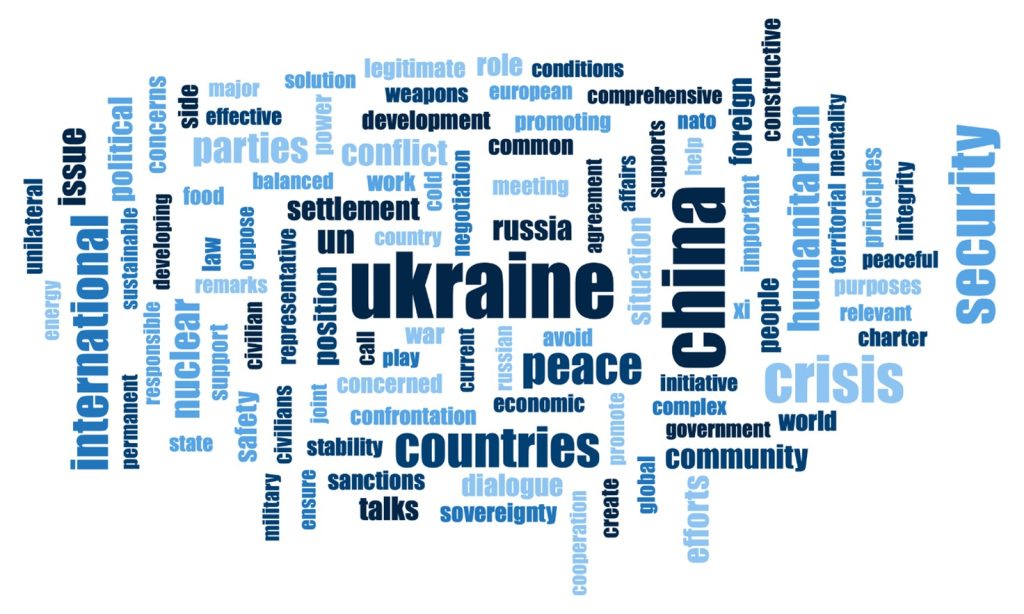
Source: Own elaboration.
After “crisis” (124) and “security” (121), the term “peace” is the most mentioned word in the Foreign Ministry spokespersons’ addresses (87 times). This is correlated directly with China’s stance, which is repeatedly said “on the side of peace, dialogue and justice” (MFA RPC, 2022a). The term is preceded by verbs such as “persevere”, “safeguard” and “promote”, highlighting Beijing’s constructive role in the international community as a guarantor of sustainable security and stability. China’s attempt to step in as a “peacemaker” becomes more evident after the release of Beijing’s 12-point position paper and the successful China-brokered agreement between the Islamic Republic of Iran and Saudi Arabia on 10 March 2023. The awaited call between Xi Jinping and Ukrainian President Volodymyr Zelensky on April 26 2023 has further promoted the narrative of China as a “true peacemaker aimed at ending the Ukraine crisis” (China Daily, 2023b) in stark opposition to those “fake” or “pseudo peace brokers”.
The claim that the PRC “is not a concerned party or bystander” and that it “can play peacemaker while the US cannot” (Gang, 2023) has been insistently reiterated by Chinese state media and the Foreign Ministry spokespersons’ remarks. Despite the criticisms vis-à-vis the Western strategic expansion being present since the early outbreak of the Ukraine crisis (Turner, 2011), the Chinese discourse has gradually taken on a markedly anti-American tone which neatly blames NATO’s enlargement and Washington’s hegemonic foreign policy as the real responsible for the Russian-Ukraine war. Thematic analyses of Chinese state media news and China’s massaging in Western social media platforms confirm the representation of the Russia-Ukraine war as a “US-born conflict” (Ran & Liu, 2024; Niblock, Hoffman & Knight, 2022; Repnikova, 2022). The prevalence of an anti-NATO and anti-US narrative that depicts them as fire igniters is exemplified by the publication from the Chinese embassy in Washington titled “Falsehoods Spread by the U.S. on the Ukraine Issue: A Reality Check” – which accuses the US and some other NATO countries of “spreading disinformation about China’s stance on the Ukraine situation” and speculating on Beijing’s awareness of the Russian intentions before the Olympics (Embassy of the PRC in the USA, 2022). The dominant trope is that all parties should draw inspiration from countries like China which “has always been on the side of peace” instead of “adding fuel to the fire and escalating tensions in an attempt to profit from it” (Permanent Mission of the PRC to the UN, 2023a). Accordingly, Beijing advocates for viewing Ukraine as “a bridge between the East and the West, not a frontier in big power confrontation” (MFA RPC, 2022b). This “bridge metaphor” has been consistently used to characterize the Chinese nationals living in Ukraine as “they all embody the bridges and bonds promoting the friendly cooperation between China and Ukraine” (MFA PRC, 2022c).
Wang Yi’s call to “wisdom” in addressing the crisis and easing tensions casts a light on China’s pertinence “in promoting peace talks in the right direction” (MFA RPC, 2022a) thanks to the “5,000 years of Chinese civilization” (zhonghua wenming wuqian nian中华文明五千年) and the so-called «Chinese values» (Zhongguo jiazhiguan 中国价值观), with wisdom as its bedrock (zhihui 智慧). As highlighted by the Permanent Representative to UN Ambassador Zhang Jun (Permanent Mission of the PRC to the UN, 2023b), the “crisis in Ukraine has brought the world to a crossroads”, presenting a “wisdom test” for the international community that can decide whether “to revert to the Cold War mentality and provoke division and confrontation, or to proceed from the common welfare of humanity and uphold equality, mutual respect, and win-win cooperation”. The employment of this type of “negative soft power” which, as suggested by Callahan (2015) is aimed at building “the positive Chinese self through the negative exclusion of Otherness” (the US and the West), is shown in the frequent correlation between NATO and expressions such as “expansion”, “confrontation” and “troublemaker” or adjectives like “irresponsible”, “unfounded”, “obsolete”, “dangerous” and “unilateral”. This messaging stresses the alliance’s responsibility in “creating imaginary enemies, destabilizing Europe and messing up the Asia Pacific” (Permanent Mission of the PRC to the UN, 2023c). Accordingly, the Ukrainian crisis is depicted as a “crisis-turned-opportunity” that may offer NATO “the oxygen” it needs for life extension (MFA RPC, 2023e). The European representation is instead mostly associated with expressions like “imbalance” and China’s subsequent call to “build a balanced, effective, and sustainable regional security architecture” (MFA RPC, 2023d). China is indeed labelled as a “responsible major country” and a “peace plan promoter” which – as a permanent member of the UN Security Council – “welcomes”, “provides” and “stands ready” to work with all parties for the broadest common understanding. Consequently, Beijing repeatedly invites the other actors to “seriously reflect”, stop “cooking up narratives” and “adopt a more responsible attitude” with particular reference to cyberspace (MFA RPC, 2022d).
The second most frequent adjective among the analysed speeches is “humanitarian”, with 67 mentions. The necessity to build humanitarian corridors for the evacuation of civilians from conflict zones is stressed in the 5th and 6th points addressed by “China’s Position on the Political Settlement of the Ukraine Crisis” (MFA RPC, 2023d). In these paragraphs, the PRC calls for the non-politicisation of humanitarian operations and the adherence to the principles of “neutrality and impartiality”. Indeed, the key narrative is that China has “always taken an objective and impartial stance based on the merits of the issue” (Permanent Mission of the PRC to the UN, 2023e).
Verbs of opposition and pronouns like “against” are mostly employed in the discourse on the risk of a nuclear war, the PRC’s “major concern” (Permanent Mission of the PRC to the UN, 2023d). The call to “abide by the nuclear safety convention and other international law” and to “bear in mind the future of humanity” goes hand in hand with the idea that all countries should pursue a “just cause for the common good” (ibid.). This appears possible if one follows the Chinese-promoted “win-win cooperation” as opposed to the US attitude of “expecting others to lose” (ibid.). Wilful disapproval is also expressed when invoking the UN Charter Chapter VII which authorizes the use of force and sanctions in the UN Security Council resolutions. Such a stance places China on the side of developing countries, “especially small and medium-sized countries”, enhancing its role as a natural member of the Global South (MFA RPC, 2022b).
Broadly speaking, the discourse on the Ukrainian war has allowed Beijing to remark that “the world is big enough to accommodate common development and progress of all countries” (Permanent Mission of the PRC to the UN, 2023c), and that “China has always faithfully fulfilled its international obligations” (MFA RPC, 2022b). This narrative strongly emerges in the “five points” on the Ukraine issue, where Wang Yi stated: “When it comes to peace and security, China has the best record among major countries. We have never invaded other countries or engaged in proxy wars, nor have we ever sought spheres of influence or participated in military bloc confrontations” (MFA PRC, 2022b). As pointed out by Millward (2023), however, the 1979 Sino-Vietnamese war and the ambiguity surrounding the referent of “we” — whether it pertains to the PRC or all Chinese states throughout history – pose empirical challenges to Wang Yi’s assertion.
The analysis showcases that Chinese responsibility is framed in terms of a dichotomization between a “responsible great power” behaviour that supports but at the same time resists the rules and norms that underpin the international system as perceived as unfair (Nordin & Smith, 2020). While Beijing urges responsibility, its proposals to address the Ukraine issue remain vague, often expressed with phrases like “(ought to be) properly addressed”, “(should be) taken seriously”, “must be prevented” or expressions such as “there is no simple solution to a complex issue”. If it appears clear that China’s position on the war does not offer concrete contributions to peace in Ukraine, it does offer insights into how Beijing conceives its global role and its inherent dilemma between assuming a global role while grappling with growing intolerance towards the existing international order.
Conclusion
The article illustrated China’s behaviour during the war in Ukraine in an effort to understand whether this can offer fresh insights into how keen China is to play the role of an international leader. This was looked at through the lenses of Chinese grand strategy and China’s discursive practices by employing a critical IR approach. Shedding light on the inner contradictions of China’s long-term trajectory – in between interests for modernisation and economic openness, and lack of trust towards a West-led international system and the need to protect itself from it – this article could identify a substantial degree of ambivalence that, even nowadays that China is overtaking the US economy, continue to characterise Beijing’s foreign policy.
In particular, during the conflict, it could be seen that China, while clearly siding diplomatically with Russia, walked a tightrope as it did not want to provide lethal weapons to Russia, and stayed away from the conflict from a military viewpoint. In other words, it could be clearly seen that while China has major interests in Europe and did not want to jeopardise these, it did not trust Europe to the point that even if it had to accept a war it disliked, it stuck to Russia’s side, as Moscow it is seen as a more reliable political partner in the long-term.
This positioning also confirmed that while for China economic interests are important, to a degree political interests – whether these involve alliances or stability of the regime – are prioritised. Such a stance was further affirmed by analysing China-Russia relations within the context of the 2008, 2014 and 2022 Olympics, which allow to capture the delicate balancing act that China undertakes between anxiety about a West-led international order – and therefore the need for “like-minded” friends such as Russia – and the necessity to reassure the world about its responsible approach to global governance, and therefore the need to engage with it to continue to pursue its modernization goals.
Beijing’s ambivalent stance over the war in Ukraine, more importantly, demonstrated that as in many other controversial issues – from the war in Israel and Palestine to the discussions on climate change – Beijing is not interested or prepared to take the lead over controversial issues, in the same way that the United States did since the end of WWII.
This, however, does allow one to exclude any possibility that China might escalate its position with regard to different crises. Indeed, it is likely that until the war in Ukraine remains local – that is, confined within Ukraine’s borders – China sees no interest in intervening in the conflict, whether directly, that is, in Eastern Europe – which is however unlikely, given Beijing’s limited power projection – or indirectly, that is in another region.
That said, the crisis has also shown different nuances. Since its very beginning, the war in Ukraine has provided Beijing with the opportunity to remark on its objectiveness and fairness in the “hot issues” of the world. The discourse analysis we developed has shown the attribution of the characteristics inherent to irresponsible leadership to the US, where hegemony is intended as “ba” (霸) – a term that origins from the Spring and Autumn period (770-454 BC.) and relates to the rule by force. In contrast, the Chinese Foreign Ministry official discourse has presented China’s wisdom as an alternative source to inspiring the world, ascribing it the “human authority” necessary to become a “cultural leadership” (wenhua lingdaoquan 文化领导权) (Yan, 2019). The findings showcase that in China’s quest for a global role, the selective use of the country’s historical and cultural traditions increasingly serve as a source for the formulation of Beijing’s foreign policy and its grand strategy architecture while trying to answer Beijing’s profound identity dilemma about “Who is China?” (Qin, 2010).
About the authors:
Dr. Zeno Leoni is a Lecturer in ‘Defence Studies’ at the Defence Studies Department of King’s College London, based within the Joint Services and Staff College (JSCSC) of the Defence Academy of the United Kingdom. His research focuses in US and Chinese grand strategies, US-China relations, AUKUS, and world order. Among his most recent publications is the book «A New Cold War. U.S.-China Relations in the 21st Century» published by Bristol University Press.
Veronica Strina is a PhD candidate in Diplomacy and International Cooperation at the University for Foreigners of Perugia and a visiting PhD student at the Defence Studies Department, King’s College London. Her research interests focus on China’s foreign policy and public diplomacy. She recently co-guested the Special Issue “Olympic Diplomacy as Contestation: the legacy of the Beijing Olympics” published by The International Spectator.
References
Antoniades, Andreas (2018), “Hegemony and international relations”, International Politics,Vol. 55, No.5, pp. 595–611.
Arrighi, Giovanni (1994), The Long Twentieth Century: Money, Power and the Origins of our Times, London: Verso.
Ash Center for Democratic Governance and Innovation (2022), “Tony Saich on Sino-Russian relations and how Beijing views the invasion of Ukraine”. https://ash.harvard.edu/tony-saich-how-beijing-views-invasion-ukraine
BBC (2019), “China’s Xi praises ‘best friend’ Putin during Russia visit”, June 6. https://www.npr.org/2019/06/06/730200317/as-relations-with-u-s-sour-xi-describes-putin-as-best-friend-at-moscow-meeting
Biscop, Sven (2021), Grand Strategy in 10 Words: A Guide to Grand Power Politics in the 21st Century, Bristol: Bristol University Press.
Brands, Hal (2014), What Good Is Grand Strategy? Power and Purpose in American Statecraft from Harry S. Truman to George W. Bush, Ithaca: Cornell University Press.
Bull, Hedley (2002), The Anarchical Society: A Study of Order in World Politics, 3rd ed., London: Routledge.
Buzan, Barry (2014), “The logic and contradictions of ‘peaceful rise/development” as China’s grand strategy’, The Chinese Journal of International Politics, Vol. 7, No. 4, pp. 381–420.
Callahan, William A. (2015), “Identity and Security in China: The Negative Soft Power of the China Dream”, Politics, Vol. 35, No. 3-4, pp. 216-229.
Chang-Liao, Nien-chung (2018), “Domestic politics and China’s assertive foreign policy: why China’s rise may not be peaceful”, in Tse-Kang, Leng & Aoyama, Rumi (Eds.), Decoding the Rise of China: Taiwanese and Japanese Perspectives, Singapore: Springer Nature.
China Daily (2023a), “Full text of Xi’s signed article on Russian media”, March 20. https://www.chinadaily.com.cn/a/202303/20/WS64178f9ba31057c47ebb54e8.html
- (2023b),“China a true peacemaker aimed at ending Ukraine crisis”,June 13.https://global.chinadaily.com.cn/a/202306/13/WS64879e44a31033ad3f7bbd79.html
Danner, Lukas K. (2018), China’s Grand Strategy Contradictory Foreign Policy?, Cham (Switzerland): Palgrave Macmillan.
Denoon, David B. H. (2021), “Conclusion”, in Denoon, David B.H. (Ed.), China’s Grand Strategy: A Road Map to Global Power, New York: New York University Press, pp. 233-253
Diodato, Emidio & Strina, Veronica (2023), “Olympic Diplomacy as Contestation: The Legacy of the Beijing Olympics”, The International Spectator, Vol. 58, No.2, pp. 1-16.
Doshi, Rush (2021), The Long Game: China’s Grand Strategy to Displace American Order, New York: Oxford University Press.
Embassy of the PRC in the USA (2022), “Falsehoods Spread by the U.S. on the Ukraine Issue: A Reality Check”, May 2. http://us.china-embassy.gov.cn/eng/zmgx/zxxx/202205/t20220503_10681306.htm
Fairclough, Norman (1995), Critical Discourse Analysis. The Critical Study of Language, London and New York: Longman.
Feigenbaum, Evan A. & Szubin, Adam (2023), “What China has learned from the Ukraine war: even great powers aren’t safe from economic warfare – if the U.S.-led order sticks together”, Foreign Affairs, February 14. https://www.foreignaffairs.com/china/what-china-has-learned-ukraine-war?utm_medium=promo_email&utm_source=lo_flows&utm_campaign=registered_user_welcome&utm_term=email_1&utm_content=20230422
France Mèdias Monde (2022), “Zhōngguó wǔ wèi lìshǐ xué jiā qiǎnzé èluósī rùqīn wūkèlán” 中国五位历史学家谴责俄罗斯入侵乌克兰 (tr. “Five Chinese historians condemn Russia’s invasion of Ukraine”), February 26. https://www.rfi.fr/cn/%E4%B8%AD%E5%9B%BD/20220226-%E4%B8%AD%E5%9B%BD%E4%BA%94%E4%BD%8D%E5%8E%86%E5%8F%B2%E5%AD%A6%E5%AE%B6%E8%B0%B4%E8%B4%A3%E4%BF%84%E7%BD%97%E6%96%AF%E5%85%A5%E4%BE%B5%E4%B9%8C%E5%85%8B%E5%85%B0
Gaddis, John Lewis (2018), On grand Strategy, London: Penguin.
Gang, Ding (2023),“China can play peacemaker while US cannot”, Global Times, March 15.https://www.globaltimes.cn/page/202303/1287319.shtml
Garver, John W. (2016), China’s Quest: The History of the Foreign Relations of the People’s Republic of China, New York: Oxford University Press.
Goldstein, Avery (2020), “China’s Grand Strategy under Xi Jinping: Reassurance, Reform, and Resistance,” International Security, Vol. 45, No. 1, pp. 164-201.
Gramsci, Antonio, (1975), Quaderni del carcere, Torino: Einaudi.
Grix, Jonathan & Kramareva, Nina (2017), “The Sochi Winter Olympics and Russia’s unique soft power strategy”, Sport in Society, Vol. 20, No. 4, pp. 461-475.
Guha, Ranajit (1998), Dominance without Hegemony. History and Power in Colonial India, Cambridge: Harvard University Press.
Heilmann, Sebastian (2017), China’s Political System, London: Rowman & Littlefield.
Kachiga, Jean (2022), The Pulse of China Grand Strategy, London: Routledge.
Keys, Barbara (2009), “International relations”, in Pope, S. W. & Nauright, John (Eds.), Routledge Companion to Sports History, London: Taylor and Francis, pp. 248-267.
Khan, Sulmaan Wasif (2018), Haunted by Chaos: China’s Grand Strategy from Mao Zedong to Xi Jinping, Cambridge (MA): Harvard University Press.
Leoni, Zeno (2021), American Grand Strategy from Obama to Trump: Imperialism After Bush and China’s Hegemonic Challenge, Cham (Switzerland): Springer nature.
- (2022), “Could China have any influence over Russia’s actions?”, King’s College London, February 25. https://www.kcl.ac.uk/could-china-have-any-influence-over-russias-actions
- (2023), Grand Strategy and the Rise of China: Made in America, Newcastle Upon Tyne: Agenda Publishing.
Leoni, Zeno & Tzinieries, Sarah (2024), “The Return of Geopolitical Blocs”, Survival, Vol. 66, No. 2, pp. 37-54.
Lukin, Artyom (2021), “The Russia–China entente and its future”, International Politics, Vol. 58, pp. 363–380.
Millward, James A. (2023), “Sinicisation, the Tribute System and Dynasties: Three Concepts to Justify Colonialism and Attack Non-Sinitic Diversity in the People’s Republic of China”, Istituto Affari Internazionali (IAI), Vol. 23, No. 17, pp. 1-17.
Mitter, Rana (2008), Modern China: A Very Short Introduction, Oxford: Oxford University Press.
MFA RPC (Ministry of Foreign Affairs of the People’s Republic of China) (2015), “Commemorating Great Victory of World War II and Composing New Chapter of Silk Road Cooperation Foreign Minister Wang Yi’s Remarks on President Xi Jinping’s Attendance at Celebrations Marking 70th Anniversary of Victory of Great Patriotic War in Russia and His Visits to Russia, Kazakhstan and Belarus”, May 13. https://www.fmprc.gov.cn/mfa_eng/topics_665678/2015zt/xjpcxelsjnwgzzsl70znqdbfelshskstbels/201505/t20150514_704955.html
- (2021a), “China’s Diplomacy in 2021: Embracing a Global Vision and Serving the Nation and its People”, December 21. https://www.mfa.gov.cn/mfa_eng/zxxx_662805/202112/t20211220_10471930.html
- (2021b), “Wang Yi Attends the Reception Celebrating the 20th Anniversary of the Signing of the China-Russia Treaty of Good-Neighborliness and Friendly Cooperation”, July 11. https://www.fmprc.gov.cn/eng/zxxx_662805/202107/t20210712_9133533.html
- (2022a), “Wang Yi Talks about China’s Five-Pronged Perseverance on Ukraine Issue”. https://www.fmprc.gov.cn/mfa_eng/zxxx_662805/202204/t20220401_10663132.html
- (2022b), “Wang Yi Expounds China’s Five-Point Position on the Current Ukraine Issue”, February 26. https://www.mfa.gov.cn/eng/zxxx_662805/202202/t20220226_10645855.html
- Wang Yi: China Attaches Great Importance to and Cares about the Safety of Chinese Compatriots in Ukraine”, 28 February. https://www.fmprc.gov.cn/eng/gjhdq_665435/2675_665437/2767_663538/2769_663542/202203/t20220301_10646642.html
- (2022d), “Spokesperson’s remarks on CNCERT’s findings of the cyberattack from the US, Germany and Netherlands on Russia, Ukraine and Belarus by controlling computers in China”, March 14. https://www.fmprc.gov.cn/eng/wjb_663304/zzjg_663340/jks_665232/jkxw_665234/202203/t20220315_10651919.html
- (2023a), “A Journey of Friendship, Cooperation and Peace that Attracts Worldwide Attention ——State Councilor and Foreign Minister Qin Gang on President Xi Jinping’s State Visit to Russia”, March 22. https://www.mfa.gov.cn/eng/zxxx_662805/202303/t20230324_11048606.html
- (2023b), “Qin Gang: China is Committed to Following A Chinese Approach to Resolving Hotspot Issues”, February 21. https://www.mfa.gov.cn/eng/zxxx_662805/202302/t20230222_11029591.html
- (2023c), “The Global Security Initiative Concept Paper”, February 21. https://www.fmprc.gov.cn/mfa_eng/wjbxw/202302/t20230221_11028348.html
- (2023d), “China’s Position on the Political Settlement of the Ukraine Crisis”, February 24. https://www.fmprc.gov.cn/eng/zxxx_662805/202302/t20230224_11030713.html
- (2023e), “Chinese Consul-General in Brisbane Ruan Zongze wrote on The Australian an op-ed article titled ‘China seeks peace in Ukraine crisis’”, March 1. https://www.fmprc.gov.cn/eng/wjb_663304/zwjg_665342/zwbd_665378/202303/t20230308_11037687.html
MND PRC (Ministry of National Defense of the People’s Republic of China) (2022), “Xíjìnpíng zhǔxí hé pǔjīng zǒngtǒng jiāng jǔxíng zì 2013 nián yǐlái dì 38 cì huìwù” 习近平主席和普京总统将举行自2013年以来第38次会晤 (tr. President Xi Jinping and President Putin will hold their 38th meeting since 2013), February 02. http://www.mod.gov.cn/gfbw/qwfb/yw_214049/4904160.html
Niblock, Igram; Hoffman, Samantha & Knight, Matthew (2022), “China’s messaging on the Ukraine conflict”, Australian Strategic Policy Institute, May 2022.
Nordin, Astrid & Smith, Graham (2020), “China’s Rise and ‘Responsibility’ in the 21st Century”, British Journal of Chinese Studies, Vol. 10, pp. 40-60.
Norris, William J. (2016), Chinese Economic Statecraft: Commercial Actors, Grand Strategy, and State Control, Itacha: Cornell University Press.
Permanent mission of the People’s Republic of China to the United Nations and other international organizations in Vienna (2012), “Full text of resolution on amendment to CPC Constitution”, November 15. http://vienna.china-mission.gov.cn/eng/zgbd/201211/t20121115_8848623.htm
Permanent Mission of the PRC to the UN (2023a), “Remarks by Ambassador Zhang Jun at the UN Security Council Briefing on Ukraine”, May 2023. https://www.fmprc.gov.cn/eng/wjb_663304/zwjg_665342/zwbd_665378/202305/t20230517_11078770.html
- (2023b), “Remarks by Ambassador Zhang Jun at the UN Security Council Briefing on Ukraine”, January 13. http://un.china-mission.gov.cn/eng/dbtxx/czdbzjds/zjdshd/202301/t20230114_11007359.htm
- (2023c), “Remarks by Ambassador Zhang Jun at the UN Security Council Briefing on Ukraine”, February 17. http://un.china-mission.gov.cn/eng/dbtxx/czdbzjds/zjdshd/202302/t20230218_11026915.htm
- (2023d), “Remarks by Ambassador Zhang Jun at the UN Security Council Briefing on Ukraine”, August 2023. http://un.china-mission.gov.cn/eng/dbtxx/czdbzjds/zjdshd/202308/t20230826_11133101.htm
- (2023e), “Remarks by Ambassador Dai Bing at the UN Security Council Briefing on the Humanitarian Issue of Ukraine”, February 6. http://un.china-mission.gov.cn/eng/hyyfy/202302/t20230207_11021043.htm
President of Russia (2022), “Joint Statement of the Russian Federation and the People’s Republic of China on the International Relations Entering a New Era and the Global Sustainable Development”, February 4. http://en.kremlin.ru/supplement/5770
Qin, Yaqing (2010), “International Society as a Process: Institutions, Identities, and China’s Peaceful Rise”, The Chinese Journal of International Politics, Vol. 3, No. 2, pp. 129–53.
Ran, Tongzhou & Liu, Zhangbo (2024), “‘The Russia-Ukraine War’ or ‘The US-Russia War’? Thematic analysis of Global Times’ coverage of the Russia-Ukraine War”, Media Asia, Vol. 51, No. 1, pp 3-32. https://doi.org/10.1080/01296612.2023.2246721
Renmin Ribao (People’s Daily) (2014), “Suǒqì zhī xíng: Dōng ào yǒuqíng zhī lǚ, kāiqǐ wàijiāo xīn piān”索契之行:冬奥友情之旅,开启外交新篇 (tr. Visit to Sochi: A Friendship Journey to Winter Olympics Opens New Chapter in Diplomacy), February 9. http://world.people.com.cn/n/2014/0209/c1002-24303047.html
Repnikova, Maria (2022), “China’s Propaganda on the War in Ukraine”, China Leadership Monitor, Vol. 72.
Reuters (2014), “As Putin looks east, China and Russia sign $400-billion gas deal”, May 21. https://www.reuters.com/article/idUSBREA4K07L/
Russian Government (2008), “Press Conferences”, August 6. http://archive.premier.gov.ru/eng/events/pressconferences/1640/
Scobell, Andrew & Feng, Zhu (2009), “Grand Strategy and U.S.-China Relations”, unpublished manuscript, Peking and College Station, Tex.: School of International Studies at Peking University and the George H. W. Bush School of Government and Public Service at Texas A&M University.
Scobell, Andrew; Burke, Edmund J.; Cooper III, Cortez A.; Lilly, Sale; Ohlandt, Chad J. R.; Warner, Eric & Williams, J. D. (2020), “China’s Grand Strategy Trends, Trajectories, and Long-Term Competition”, RAND, July 24. https://www.rand.org/pubs/research_reports/RR2798.html
Spektor, Matias (2023), “In defense of the fence sitters: what the west gets wrong about hedging”, Foreign Affairs, Vol. 102, No. 3, pp. 8-16.
Stranjio, Sebastian (2021), “China Steps Toward De Facto Recognition of Myanmar’s Junta”, The Diplomat, June 7. https://thediplomat.com/2021/06/china-steps-toward-de-facto-recognition-of-myanmars-junta/
Swaine, Michael D. & Tellis, Ashley J. (2000), Interpreting China’s Grand Strategy: Past, Present, and Future, Santa Monica: RAND.
Thomas, Timothy L. (2014), China Military Strategy: Basic Concepts and Examples of its Use, Fort Leavenworth (KS): Foreign Military Studies Office (FMSO).
Tian, Yew Lun (2022), “China blames NATO for pushing Russia-Ukraine tension to ‘breaking point’”, Reuters, March 9. https://www.reuters.com/world/china-blames-nato-pushing-russia-ukraine-tension-breaking-point-2022-03-09/
Trenin, Dmitry (2008), “The New World Order—What Is It?”, The New Times, Vol. 36, pp. 8-11.
Turner, Susan (2011), “China and Russia After the Russian-Georgian War”, Comparative Strategy, Vol. 30, No. 1, pp. 50–59.
Wang, Jisi (2012), “China’s search for a grand strategy: a rising great power finds its way”, Foreign Affairs, Vol. 90, No. 2, pp. 68-79.
Westad, Odd A. (2022), “The next Sino-Russian split? Beijing will ultimately come to regret its support of Moscow”, Foreign Affairs, April 5. https://www.foreignaffairs.com/articles/east-asia/2022-04-05/next-sino-russian-split
White, Hugh (2013), The China Choice: Why We Should Share Power, Oxford: Oxford
University Press.
Wishnick, Elizabeth (2017), “In search of the ‘Other’ in Asia: Russia–China relations revisited”, The Pacific Review, Vol. 30, No. 1, pp. 114-132.
- (2009), Russia, China, and the United States in Central Asia: prospects for great power competition and cooperation in the shadow of the Georgian crisis, Carlisle: US Army War College Press.
Wu, Guoguang (2023), “Interpreting Xi Jinping’s Shifting Strategy on the Russia-Ukraine War”, Asia Society Policy Institute,October 2023.
Yan, Xuetong (2019), Leadership and the Rise of Great Powers, The Princeton-China Series: Princeton University Press.
Ye, Zicheng (2011), Inside China’s Grand Strategy: the Perspective from the People’s Republic, United States of America: The University Press of Kentucky.
You, Ji (2011), “Dealing with the ‘North Korea Dilemma’: China’s Strategic Choices”, RSIS Working Paper, No. 229. https://www.rsis.edu.sg/wp-content/uploads/2014/07/WP2295.pdf
Zhang, Ketian (2024), China’s Gambit: The Calculus of Coercion, Cambridge: Cambridge University Press.
Zhang, Weiwei (2011), The China Wave: Rise of a Civilizational State, Shanghai: World Century.
Zheng, Cheng (2016), “China Debates the Non-Interference Principle”, The Chinese Journal of International Politics, Vol. 9, No. 3, pp. 349-374.
Zhou, Bo (2022), “Senior Colonel Zhou Bo says the war in Ukraine will accelerate the geopolitical shift from West to East”, The Economist, May 14. https://www.economist.com/by-invitation/2022/05/14/senior-colonel-zhou-bo-says-the-war-in-ukraine-will-accelerate-the-geopolitical-shift-from-west-to-east
Zhu, Feng (2008), “The Russia–Georgia military conflict: for China, does it mean scrambling between a ‘strategic partnership’ and being a ‘responsible stakeholder’?”, Korean Journal of Defense Analysis, Vol. 20, No. 4, pp. 305–318.
[1] As Garver stated, grand strategic thinking was underpinned by a certain ‘humility’ (Garver, 2016: 429).
[2] Furthermore, it was reported that “China-Russia trade rose by a staggering 34.3 percent in 2022 to a record $190 billion” (Feigenbaum & Szubin, 2023).
[3] The prioritization of long-term political interests as opposed to short-term economic interests, is a dynamic that was seen at play also during the era of (much prolonged) physical restrictions for the containment of Covid-19.