MARCUS VINICIUS GONÇALVES DA SILVA
Pontifical Catholic University of Paraná, Brazil
JANSEN MAIA DEL CORSO
Pontifical Catholic University of Paraná, Brazil
Título: Administración y Defensa Nacional: análisis de la relación entre dos áreas del conocimiento científico en Brasil
Abstract: In Brazil, it is observed that the researchers in the field of Administration keep a certain distance to studies of National Defense. In this direction, the scope of this study is that there is an incapability between the strategic actions provided for in the National Defense Strategy (NDS) and the capabilities of the Defense Industry Base (DIB). It is assumed that companies linked to the DIB must know their dynamic capabilities, so that they can, in their strategic planning, develop actions that allow them to cooperate with the NDS, in addition to generating competitive advantage. The methodology used has a bibliometric nature. The findings point to i) the lack of studies that aim to propose strategies for the Defense sector, from the perspective of the theory of dynamic capabilities and business strategy; ii) the inexistence of Stricto Sensu Post-Graduate Programs in Administration, which have in their lines of research the National Defense theme; and, iii) the inexistence of journals in the area of Administration that have as scope or focus organizational studies, strategy and innovation in the area of National Defense. The Administration area has lines of research that cover strategic and organizational studies, innovation and technology, governance, public finance and others, which can collaborate with the advancement of studies on Defense in an applied way, as they aim to relate theory to practice and the constant search for pragmatic solutions to symptomatic and ongoing problems, through analytical, in-depth scientific methods and empirical observation.
Keywords: Defense Policies, National Defense, Organizational Theories, Management, International Relations.
Resumen: En Brasil, se observa que los investigadores en el campo de la Administración guardan cierta distancia de los estudios de Defensa Nacional. En este sentido, el alcance de este estudio es que existe una incapacidad entre las acciones estratégicas previstas en la Estrategia de Defensa Nacional (NDS) y las capacidades de la Base de la Industria de Defensa (DIB). Se asume que las empresas vinculadas a la DIB deben conocer sus capacidades dinámicas, para que puedan, en su planificación estratégica, desarrollar acciones que les permitan cooperar con la NDS, además de generar ventaja competitiva. La metodología utilizada tiene un carácter bibliométrico. Los hallazgos apuntan a i) la falta de estudios que apunten a proponer estrategias para el sector Defensa, desde la perspectiva de la teoría de las capacidades dinámicas y la estrategia empresarial; ii) la inexistencia de Programas de Posgrado en Administración Stricto Sensu, que tengan en sus líneas de investigación el tema de la Defensa Nacional; y, iii) la inexistencia de revistas del área de Administración que tengan como ámbito o enfoque los estudios organizacionales, la estrategia y la innovación en el área de la Defensa Nacional. El área de Administración cuenta con líneas de investigación que abarcan estudios estratégicos y organizacionales, innovación y tecnología, gobernanza, finanzas públicas y otros, que pueden colaborar con el avance de los estudios en Defensa de forma aplicada, ya que tienen como objetivo relacionar la teoría con la práctica y la búsqueda constante de soluciones pragmáticas a problemas sintomáticos y en curso, a través de métodos analíticos, científicos profundos y observación empírica.
Palabras clave: Políticas de Defensa, Defensa Nacional, Teorías Organizacionales, Administración, Relaciones Internacionales.
Para citar este artículo/To cite this article: Marcus Vinicius Gonçalves da Silva y Jansen Maia del Corso, <<Administration and National Defense: Analysis of the relationship between two areas of scientific knowledge in Brazil>>, Revista de Estudios en Seguridad Internacional, Vol. 8, No. 1, (2022), pp. 121-141. DOI: http://dx.doi.org.10.18847/1.15.8
Introduction
It is widely assumed in the academic literature, despite some skepticism, that most people know nothing about Defense policies and the Armed Forces and, consequently, knowledge in this field is quite limited (Steinbrecher & Biehl, 2020). This diagnosis is common and characteristic of almost all Western societies (Moskos & Burk, 1994).
In the United States, Brooks (2016) describes that there is a coexistence between “enthusiasm and ignorance” and ironically states that
Most Americans know as much about the US military as they do about the surface of the moon. It’s not that Americans don’t like the military – most support it wholeheartedly. We just have no idea who is in it, what it does, how much it costs, or what current US military policies cost us (Brooks, 2016: 22).
In Latin America, Pio-Berlin (2005) notes that there is a consensus in the academic community that civil servants in the Ministries of Defense and legislative committees suffer from an appreciable deficit in knowledge of defense matters. In this context, in Brazil, specifically, there is a distance between researchers in the area of Administration, in relation to the contribution to National Defense studies, from an integrated view of the country, related to dynamic capabilities and available resources.
However, knowledge from academia has become a preponderant factor in the processes of competitiveness and capacity in the international defense system, constituting a fundamental element in strategic projects for the modernization of the Brazilian Armed Forces.
The National Defense Strategy (NDS) postulates that there should have a greater integration between scientific and technological institutions, both military and civilian (Estratégia Nacional de Defesa [END], 2020). However, notably, few higher education institutions in the country have Stricto Sensu Post-Graduate Programs that cover Defense studies, most of which are civil and come from the areas of International Relations and Political Science, being a paradigm to be overcome.
In a recent study by White (2019), the author suggests that paradigms both play a distinct role in the theoretical construction of many researches in the area and reduce the scientific innovative potential. Thus, the development of a certain research area in a paradigmatic way impairs the development of new knowledge and approaches in the field of study.
Although, the field of Administration has lines of research that include strategic and organizational studies, innovation and technology, governance and public finance, etc., which can collaborate with the advancement of studies on Defense, as they are areas that aim to relate theory to practice and the constant search for pragmatic solutions to symptomatic and continuous problems, through analytical scientific methods, in depth and empirical observation.
The topic is a research opportunity, as the academic literature has sought to analyze the relationship between different areas of research, and the interdisciplinary approach or distance in the academic process (White, 2019; Cancela, Coelho & Ruivo, 2014; Boncourt, 2007).
In this context, it is observed that different perspectives can contribute to the understanding of the role of certain causal mechanisms and are useful for researchers who wish to analyze thematic relationships (White, 2019).
Through an initial survey, it was observed in the Quadrennial Evaluation Report – 2017, organized by the Coordination for the Improvement of Higher Education Personnel, that there are 129 (one hundred and twenty-nine) Graduate Programs (PPGs) (Master’s) in Brazil and Doctorate) in Administration (Coordination for the Improvement of Higher Education Personnel [CAPES], 2017).
In the field of Administration studies, in most of the PPGs there are lines of research on Organizational Strategy. Broadly, strategic studies can be divided into two categories: one that analyzes the external environment and one that considers the internal environment (Porter, 1980). The Dynamic Capabilities (DC) theory constitutes of an affluent branch of research activities in Administration. The importance of this concept lies in the fact that it deals with how companies can achieve and sustain competitive advantages in a constantly changing environment (Nelson, 1991; Teece & Pisano, 1994; Teece, Pisano & Shuen, 1997).
In this context, the choice of the theme is justified by the presence of the Defense Industrial Base (DIB), which, according to data from August 2021, is composed of 118 (one hundred and eighteen) Strategic Defense Companies (EED) and 28 (twenty-eight) Defense Companies (DC) (Defense Industry Joint Commission [CMID], 2021). Given the above, this study seeks an answer to the following research question: What has been the contribution of Brazilian researchers in the scientific field of administration in National Defense studies?
To answer this question, this study is divided into five chapters, including this introduction. In Chapter 2, the concepts of the National Defense Strategy, the Defense Industrial Base, the Dynamic Capabilities and their relationship with the strategy are briefly presented. Chapter 3 addresses the methodological path adopted to achieve the proposed objective. In Chapter 4, the results are presented and, finally, in Chapter 5 the conclusion.
Conceptual approach
The following concepts seek to briefly describe the elements that compound the bibliographic research carried out in this research.
National Defense Strategy
The NDS, a political defense document, is formulated based on employment hypotheses that are defined considering the threats to the country, establishing guidelines for the adequate preparation and Armed Forces training, emphasizing the need for strengthening the strategic sectors in the pursuit of national development.
It highlights, among other guidelines, the need to develop the potential for military and national mobilization to ensure the deterrent and operational capacity of the Armed Forces, meaning that, the NDS is inseparable from the national development strategy.
In this context, it is essential to obtain military defense capabilities through the development of the country’s industrial, scientific-technological and logistical base, as well as its knowledge. It is, therefore, essential to have an autochthonous Defense Industrial Base (DIB) involved in research, development, production and services to meet the needs of national defense.
Defense Industrial Base
The DIB is an essential element of a State’s defense, and its importance comes both from its strategic character, resulting from the production of the country’s defense equipment, essential to guarantee defense and its autonomy, as well as its economic aspects, related to the domain of sensitive technologies, many of a dual character, and the generation of innovation, high-skilled jobs and high value-added exports.
Among the public policies aimed at national defense, the National Policy for the Defense Industry (NPDI) (Portaria Normativa nº 899, de 19 de julho de 2005) has a prominent role in emphasizing the defense industry. This policy establishes, among its specific objectives, the progressive reduction of external dependence on strategic defense products, in order to develop and produce them internally, and also to increase the competitiveness of the Brazilian DIB to expand exports. It is noted that the DIB concept gained expression in the NPDI approved by an ordinance of the Ministry of Defense, in 2005:
Defense Industrial Base is the set of state and private companies, as well as civil and military organizations, that participate in one or more of the stages of research, development, production, distribution and maintenance of strategic defense products (Portaria Normativa nº 899, de 19 de julho de 2005).
The DIB’s training, including the mastery of dual-use technologies, is essential to maintain the supply of defense products aimed for the country’s technological autonomy. The DIB’s opportunities for technological evolution are directly related to the increasing level of interaction between institutions in the field of Science, Technology & Innovation (ST&I), and the absorption of knowledge from countries with recognized technological development (END, 2020).
NDS (2020) devoted special attention in their text to the DIB, highlighting the prioritization of the development of independent technological capabilities, the subordination of commercial considerations to strategic imperatives and the use of defense technology development as a focus for the development of operational capabilities.
The prospect of expanding demand for strategic defense products offers an excellent opportunity for the development and strengthening of the DIB. However, it is highlighted in NDS that, in order to competitively consolidate the national defense industry, it is necessary to increase investments in ST&I, expand participation in domestic and foreign markets and strengthen the supply chain in Brazil.
Amarante (2012: 39) observes that the NDS «established guidelines encouraging the interaction of the most varied institutions and companies in integrated work, aimed at strengthening the DIB», with the great strategic objective of the NDS being the scientific and technological training of the country in the military sector.
Melo (2015) points out that the productive capacity of the DIB presents some challenges, including
▪ partial technological autonomy;
▪ incomplete production structure;
▪ few national anchor companies with a business, production and financial scale, compatible with the standard of international competition;
▪ educational, scientific and technological infrastructure still deficient;
▪ reduced density of the production chain, which prevents further productive and technological linkages (Melo, 2015: 28).
In this context, the DIB’s transformation process needs to be a priority in state policies so that it can incorporate the real strategic and economic benefits for the country, enabling the expansion of the national productive, technological and competitive capacities.
Dynamic Capabilities
The theory of Resource Based View (RBV), by Barney (1991), explains that a sustained competitive advantage is obtained with the company’s internal resources, which are rare, valuable, difficult to imitate and irreplaceable. However, resources and capabilities change over time and the environment influences them (Helfat & Peteraf, 2009).
The DC appears as a complement to RBV, addressing the market dynamism and the evolution of companies, seeking to explain the mechanisms of business transformation (Wang & Ahmed, 2007).
For Barney (1991), Alcantara, Lima, Cardoso & Gohr (2015) and Trindade, Trindade, & Nogueira (2015), resources are summarized in the combination of assets, skills, organizational processes, information, knowledge, formal and informal planning, and other factors controlled by the company that enable the implementation of strategies that improve the organization’s efficiency and effectiveness.
The literature on strategic management has pointed out that sources of competitive advantages come from a set of capabilities that the organization develop to renew and reconfigure its assets – tangible and intangible (Teece et al., 1997; Eisenhardt & Martin, 2000; Vasconcelos & Cyrino , 2000; Teece, 2007).
These capabilities are called dynamic capabilities. The term capability emphasizes the key role of the strategic management in adapting appropriately; integrating and reconfiguring external and internal organizational skills; as well as functional competences, with a market view (Teece et al., 1997). The term dynamic is related to the ability to build new forms of competitive advantages, through the renewal of competences, aiming to achieve congruence with the changing business environment. All of this in a context of reduced market time, technological changes in shorter times and little competitive predictability (Bergman, Jantunen & Saksa, 2004).
Leite (2011) observes that in the military context, Capability Based Planning seeks to identify the required defense capabilities, their development and their implementation, in the short to long term, using an effects-based approach (Effects Based Operations). This concept differs from concepts related to dynamic capabilities theories, as it has a broader approach.
DC constitute change and innovation management mechanisms and involve aspects of knowledge and organizational learning (Zollo & Winter, 2002). Thus, it is clear that there is a relationship between dynamic capabilities and innovation, as organizational innovation is correlated to the development of capabilities, competences, processes and organizational routines (Schumpeter, 1988).
From this perspective, through a literature review, the following topics are presented with an overview of higher education institutions, graduate programs, journals and articles related to National Defense studies, in order to verify what has been the contribution of researchers in the field of Administration, in particular, with the use of theories of strategic administration and dynamic capabilities.
Methodology
This research was restricted to documents available in the Scopus database, one of the most relevant knowledge bases, due to the quantity and impact of the works indexed in it. Considering the objective of mapping the international scientific production on defense, strategy and capability, the analysis was exploratory and descriptive. Figure 1 illustrates the steps taken to constitute the study sample.
Figure 1. Bibliometric Analysis

In the first step, an initial query was carried out based on previously established criteria for the systematic search of the documents to be analyzed and resulted in 337.908 documents containing the exact expressions “defense”, “strategy” and “capability” in the field “title”, “abstract” and “keywords”, with the use of the boolean operator “and”, and publications related to “articles”, with “open access”, in the period “2009-2019”.
The use of “key words” in scientific production proves to be useful in indexing search engines or text categorization (Ercan & Cicekli, 2007). However, to be effective, “keywords” must represent the content of the search and be specific to the search field or subfield.
The “key words”, that is, vocabulary terms taken from the documents, correspond to a choice of the authors, seeking to enhance access to scientific publications, and to synthesize the authors’ thoughts in contact with the social reality produced in the documents.
Thus, the keywords were introduced, followed by an asterisk (*) at the end, making it possible to identify all possible variations of the word in relation to the last letter, such as singular and plurals. The first filter applied limited the search to the type of source “journals”, languages “English” and “Portuguese”, and in the area of “business, management and accounting”, resulting in 5,446 articles.
A second filter delimited the search in scientific articles that contained the Keywords: strategy, dynamic capabilities, capabilities, strategic approach, innovation strategy, strategies, resulting in 317 documents. In a third filter, the documents of the field «country/territory»: Brazil were searched, in order to analyze the context of the national sectorial environment of Brazilian defense, covering actors and factors with peculiar characteristics of the country, which consisted of a final sample of 58 documents.
Results and discussions
At this stage, the abstract reading of the 58 articles was carried out, in order to verify whether the works produced contemplated the themes «strategy» and «capacities» in the «defence» area, with only the article being located from “The National Defense Strategy of Brazil and other BRICs in a comparative perspective (The National Defense Strategy of Brazil and that of the other BRICs in a comparative perspective), by Bertonha (2013), published in the Brazilian Magazine of International Policy.
We sought, then, to analyze the 26 (twenty-six) journals that published articles with at least two frequencies (≥ 2), with the words: strategy and capabilities, finding eight journals (Graph 1).
These eight journals published 40 (forty) articles, in the period of 2009 to 2019, which contained the words strategy and capabilities at the same time, corresponding to 68.9% of the total sample, that is, 58 articles.
Graph 1. Administration area journals that published articles (≥ 2) with the words: strategy and capabilities in the period of 2009 to 2019
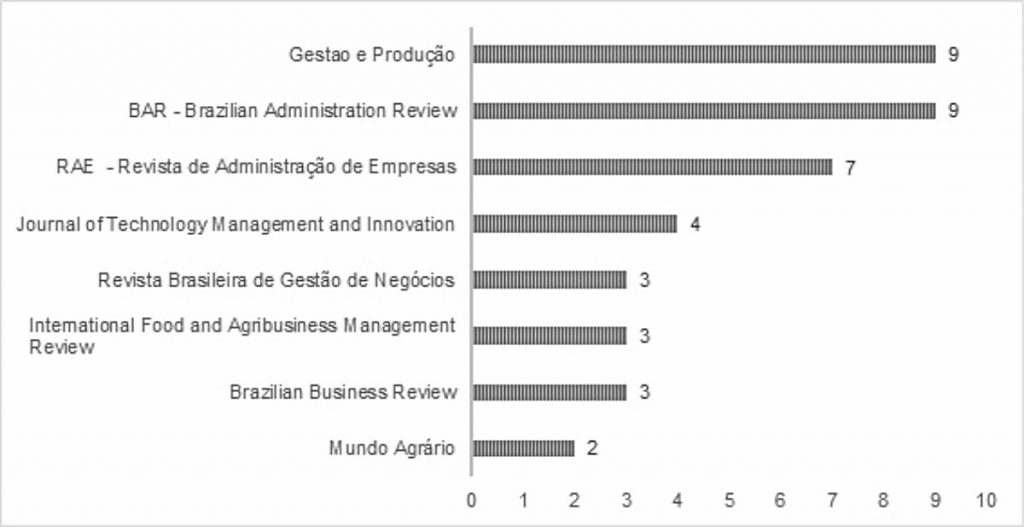
Although, when analyzing the focus and scope of the 26 (twenty-six) periodicals, it was found that even though they had publications that covered the themes of strategy and capabilities, none of them were related to the theme − Defense. It was possible to identify that researchers in the Administration field have not published, in the last ten years (2009-2019), scientific articles related to the themes of strategy and capabilities in the area of National Defense.
Analysis of Publications in the CAPES Theses & Dissertations Catalog
At this stage of the analysis, searches were carried out in the Theses & Dissertations Catalog – CAPES, in order to identify published works that were related to the Defense area. An initial search was carried out with the term national defense, finding 321 documents, corresponding to 235 (two hundred and thirty-five) dissertations and 68 (sixty-eight) theses.
After applying the first filter, the publications were delimited to the period of 2009 to 2019, resulting in only 53 (fifty-three) theses out of 167,729 (one hundred and sixty-seven thousand, seven hundred and twenty-nine theses) published, corresponding to 0,0315% of the total (extraction date: October 29, 2019). In the next step, the theses were filtered by areas of knowledge (Graph 2).
Graph 2. Areas of knowledge related to Theses published on the topic of National Defense

It is noted that in the area of Administration, only one thesis was found, entitled «The New Demands of Security and National Defense and their Impacts on the Organizational Transformation of Military Environments, particularly, of the Brazilian Army», by Neto (2015), from Getúlio Vargas Foundation (FGV), Rio de Janeiro. The study was related to the research line “Institutions, Policies and Government (Macro): with focus on the Institutional level and on the Policy Formulation Process”.
Analysis of Higher Education Institutions
Regarding the Higher Education Institutions (HEIs), which had theses published related to the area of Defense, 21 (twenty-one) were identified. It can be seen in Graph 3 that the Federal University of Rio de Janeiro (URFRJ), with a Doctorate in Comparative History (PPGHC), and the School of Command and General Staff of the Army (ECEME), with a Doctorate in Military Science (PPGCM), are the institutions that have the largest number of theses published in the area of Defense, with a total of 10 (ten) each.
Graph 3. Higher Education Institutions that had theses published related to the area of Defense

It should be noted that the Naval War College has a Professional Doctorate in Maritime Studies, which seeks to connect and relate to the world’s seas and inland waters, and has three lines of research: i) maritime policy and strategy; ii) regulation of the use of the sea, decision-making process and prospective methods; and iii) policy and management in science, technology and innovation in the maritime environment (Escola de Guerra Naval, 2020), but in this Doctorate, no thesis was found in the CAPES Theses & Dissertations Catalog related to the Defense area.
Analysis of Stricto Sensu Graduate Programs and their periodicals
At this stage, we sought to identify which Higher Education Institutions (HEIs) have in their Postgraduate Programs Stricto Sensu – Doctorate, lines of research related to the area of Defense, and which have journals focused on this area.
Of the 21 (twenty-one) HEIs, the Doctorate in Military Science, from the School of ECEME, the Doctorate in Political Science, from the Federal University of Rio Grande do Sul (UFRGS) and the Doctorate in International Relations, from Brasília University (UNB), have lines of research, specifically focused on the study of Defense, as well as periodicals that have in their scope the publication of articles related to Security, Politics and National Defense (Exhibit 1).
The Graduate Program in Maritime Studies at the Escola de Guerra Naval has a scientific journal, but its editorial scope focuses on works that contribute to the development of strategic thinking regarding Maritime Power (Revista da Escola de Guerra Naval, 2020).
Exhibit 1. HEIs that have lines of research in the area of Defense
| INSTITUTION | PPG | RESEARCH SCOPE | JOURNAL | QUALIS/ CAPES (2013-2016) | FIELD OF EVALUATION |
| School of Command and General Staff of the Army (ECEME) | Doctorate in Military Science | Defense management: Public policies, Economy and Industry | Coleção Meira Mattos | B2 | Political Science and International Relations |
| Federal University of Rio Grande do Sul (UFRGS) | the Doctorate in Political Science | International and Defence Policy | Debates Magazine | B2 | Political Science and International Relations |
| Brasília University (UNB) | Doctorate in International Relations | International Safety and Democracy | Brazilian Magazine of International Policy | A1 | Political Science and International Relations |
This survey is considered relevant, as it allows analyzing the scientific articles that were published in these journals, and whether any of them covered the tripod: strategy – dynamic capabilities – defense. It is noteworthy that in the initial survey carried out in the Scopus databases, the journals Meira Mattos Collection and Debates Magazine were not located, as they were not indexed in that database.
The Meira Mattos Collection is an interdisciplinary journal that publishes peer-reviewed articles related to Security, Defense and Military Science, with the purpose of promoting dialogue between academics and professionals, integrating issues about the Armed Forces and Society.
In this journal, a search was carried out in scientific articles published in the period of 2009-2019, with the words strategy [and] capabilities [and] defense, in the title, abstract and keywords, being located 15 (fifteen) articles, described on Exhibit 2.
Exhibit 2. Articles published with the words: Strategy or defense or capabilities in the area of Defense
| ARTICLE | AUTHORS | YEAR |
| A Inserção Internacional do Brasil e os Novos desafios à Política de Defesa Nacional | Nascimento, P. R. L. | 2010 |
| A Estratégia Nacional de Defesa e o Orçamento da União | Moraes, M. C. | 2010 |
| A Estratégia Nacional de Defesa: Reflexão sobre o Papel da Sociedade na Construção da defesa Nacional | Ferreira, M. W. S. | 2010 |
| Planejamento Estratégico das Forças Armadas Baseado em Capacidades: Reflexos para o Exército Brasileiro | Leite, M. D. A. | 2011 |
| A Implementação de Políticas Públicas para a Mobilização Nacional: a inserção do tema mobilização no Livro Branco de Defesa | Ramos, C. E. F. | 2011 |
| Estratégia: Ação ou Retórica? | Lima, R. N. O. | 2012 |
| A Nova Estrutura do Sistema de Ciência e Tecnologia do Exército e a Produção de conhecimentos e Inovações Tecnológicas para a Área de Defesa | Pellanda, P. C. | 2013 |
| A Política de Defesa do Brasil no Século XXI | Corrêa, G. C. | 2014 |
| Planejamento Estratégico Militar versus Planejamento Estratégico Empresarial: análise de métodos e resultados | Rainha et al. | 2014 |
| O perfil dos Líderes Estratégicos do Exército Brasileiro em seu Processo de Transformação | Cruz, M. P. | 2015 |
| Formulação de Políticas Setoriais em Defesa Nacional e Segurança: a Gestão de Propriedade Intelectual e Inovação nas Forças Armadas | Corrêa & Bondarczuk | 2015 |
| Investimentos na Indústria de Defesa do Brasil e da Argentina | Alves et al. | 2018 |
| Os Elementos de Análise da Cultura de Inovação no Setor de Defesa e seu Modelo Tridimensional | Azevedo, C. E. F. | 2018 |
| As Ciências Militares e a Configuração dos Estudos de Defesa como Área do Conhecimento Científico | Cunha & Migon | 2019 |
| A Construção do Pensamento em Segurança e Defesa na Academia Brasileira | Visentini & Thudium | 2019 |
The Debates Magazine is edited by the Research Center in Latin America (NUPESAL) in partnership with the Postgraduate Program in Political Science at UFRGS, and its main objective is to constitute a space for debate and confrontation on contemporary issues in the field of Science Humanities and Political Science, approached from a multiplicity of perspectives. In this journal, two articles were located, as shown in Exhibit 3.
Exhibit 3. Articles published with the words: Strategy or defense or capabilities in the area of Defense
| TITLE | AUTHORS | YEAR |
| Dilemas da Grande Estratégia das Forças Armadas do Brasil nos Anos 1980 e 1990: o debate interno em um Sistema Internacional em Transição | Nunes & Svartman | 2019 |
| Política Externa, Segurança e Defesa nos governos Lula e Cardoso | Machado da Silva, M. V. | 2010 |
The Brazilian Journal of International Politics (RBPI) is the oldest publication specialized in the themes of the international agenda, considered one of the most traditional in South America. The RBPI examines the broad field of International Relations from various perspectives and themes related to politics, economics, sociology, security, environment and other contemporary issues. Three articles were located in the RBPI (Exhibit 4).
Exhibit 4. Articles published with the words: Strategy or defense or capabilities in the area of Defense
| TITLE | AUTHORS | YEAR |
| Brazilian National Defence Policy and Strategy Reviewed as a Unity. | Proença Jr & Lessa | 2017 |
| A Estratégia Nacional de Defesa do Brasil e a dos outros BRICS em perspectiva comparada | Bertonha, J. F. | 2013 |
| Segurança e Defesa Nacionais: conceitos básicos para uma análise | Rudzit & Nogami | 2010 |
According to the survey carried out in the articles of the magazines Meira Mattos Collection, Debates and the Brazilian Journal of International Politics, 20 (twenty) articles were identified that published subjects related to the terms strategy or defense or capabilities. Given this result, we sought to identify the keywords that were used in these studies.
Keyword analysis of published articles
Ercan and Cicekli (2007) point out that the survey of keywords in various academic and scientific works aims to measure the scope of a theme or subject and its main concepts. This procedure proves to be useful for indexing works in databases, search engines or text categorization.
Keywords increase access to the content of documents, in addition to the information that is represented by the title and abstract, as it translates and synthesizes the authors’ thoughts, and allows the monitoring of the evolution of science, reflected in the documents.
In bibliometric studies and in the survey of the state of the art of the literature, keywords have been widely used by researchers in the collection of data from the main national and international databases. Exhibit 5 presents the keywords used in the 20 (twenty) articles published, observed in the previous tables.
Exhibit 5. Keywords used in articles on the topic of National Defense
| MEIRA MATTOS COLLECTION | |
| ARTICLE | KEYWORDS |
| A Inserção Internacional do Brasil e os Novos desafios à Política de Defesa Nacional | International insertion. Defense Policy. EB/2022 Scenarios. |
| Brazil’s International Insertion and New Challenges to the National Defense Policy | |
| A Estratégia Nacional de Defesa e o Orçamento da União | National Defense Strategy. Union Budget. Civil society. National development. Financial resources. |
| The National Defense Strategy and the Union Budget |
| A Estratégia Nacional de Defesa: Reflexão sobre o Papel da Sociedade na Construção da defesa Nacional | Strategy. National Defense. Society. Brazilian State. Sovereignty. |
| The National Defense Strategy: Reflection on the Role of Society in Building National Defense | |
| Planejamento Estratégico das Forças Armadas Baseado em Capacidades: Reflexos para o Exército Brasileiro | Capability-Based Planning. Military Strategic Planning System. Brazilian Army. |
| Capabilities-Based Strategic Planning of the Armed Forces: Reflections for the Brazilian Army | |
| A Nova Estruturação do Sistema de Ciência e Tecnologia do Exército e a Produção de conhecimentos e Inovações Tecnológicas para a Área de Defesa | Defense Engineering. Technologic innovation. Research and Development. |
| The New Structuring of the Army’s Science and Technology System and the Production of Knowledge and Technological Innovations for the Defense Area | |
| A Política de Defesa do Brasil no Século XXI | Defense Policy. National Strategy. Armed Forces. Defense White Paper. Challenger. |
| Brazil’s Defense Policy in the 21st Century | |
| Planejamento Estratégico Militar versus Planejamento Estratégico Empresarial: análise de métodos e resultados | Strategic Planning. Military Strategic Planning. Strategic Business Planning. Methods. Results. |
| Strategic Military Planning versus Strategic Business Planning: analysis of methods and results | |
| O perfil dos Líderes Estratégicos do Exército Brasileiro em seu Processo de Transformação | Profile. Strategic leadership. Strategic environment. Transformation process. Brazilian Army. |
| The profile of the Brazilian Army’s Strategic Leaders in its Transformation Process | |
| Formulação de Políticas Setoriais em Defesa Nacional e Segurança: a Gestão de Propriedade Intelectual e Inovação nas Forças Armadas | Politics. Defense. Brazil. Intellectual property. Innovation. |
| Formulation of Sectoral Policies in National Defense and Security: the Management of Intellectual Property and Innovation in the Armed Forces | |
| Investimentos na Indústria de Defesa do Brasil e da Argentina | Defense Industry. Military expenses. Investments. Brazil. Argentina. |
| Investments in the Defense Industry of Brazil and Argentina | |
| Os Elementos de Análise da Cultura de Inovação no Setor de Defesa e seu Modelo Tridimensional | Culture of Innovation. Defense Transformation. Defense Industrial Base. Organizational culture. |
| The Elements of Analysis of the Innovation Culture in the Defense Sector and its Three-Dimensional Model | |
| As Ciências Militares e a Configuração dos Estudos de Defesa como Área do Conhecimento Científico | National defense. Postgraduate studies. Armed forces. Army. ECEME |
| Military Sciences and the Configuration of Defense Studies as an Area of Scientific Knowledge | |
| A Construção do Pensamento em Segurança e Defesa na Academia Brasileira | National defense. International Security. Academy and Armed Forces. |
| The Construction of Security and Defense Thought in the Brazilian Academy | |
| DEBATES MAGAZINE | |
| ARTICLE | KEYWORDS |
| Dilemas da Grande Estratégia das Forças Armadas do Brasil nos Anos 1980 e 1990: o debate interno em um Sistema Internacional em Transição | Brazil. Grand Strategy. Armed Forces. Discursive Institutionalism. |
| Dilemmas of the Great Strategy of the Armed Forces from Brazil in the 1980s and 1990s: the internal debate in an International System in Transition |
| Política Externa, Segurança e Defesa nos governos Lula e Cardoso | Disarmament and Control of Nuclear Weapons. Lula and Cardoso governments. Peace Operations. Brazilian Foreign Policy. Security and Defense. |
| Foreign Policy, Security and Defense in the Lula and Cardoso administrations | |
| BRAZILIAN MAGAZINE OF INTERNATIONAL POLICY | |
| ARTICLE | KEYWORDS |
| Brazilian National Defence Policy and Strategy Reviewed as a Unity | Armed forces. Brazil. Defense Policy. Science, Technology and Innovation. Strategic Studies. Strategy. |
| Brazilian National Defense Policy and Strategy Reviewed as a Unity | |
| A Estratégia Nacional de Defesa do Brasil e a dos outros BRICS em perspectiva comparada | Brazil. China. National Strategies. National Defense Strategies. India. Russia. |
| The National Defense Strategy of Brazil and that of other BRICS in a comparative perspective | |
| Segurança e Defesa Nacionais: conceitos básicos para uma análise | International Security. National security. Defense. |
| National Security and Defense: Basic Concepts for an Analysis |
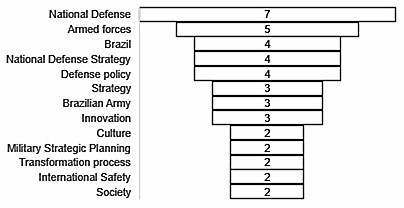
Graph 4 shows the distribution of the 43 most cited keywords in the 20 (twenty) studies on national defense scope with more than two citations (≥2).
It is noteworthy that only one article contains in its keywords the term capabilities, which is entitled − Strategic Planning of the Armed Forces Based on Capabilities: reflexes for the Brazilian Army, by Leite (2011). The article aims to verify the extent to which the adoption of Capacity-Based Planning (PBC) has implications for the sub-sector level of the Brazilian Military Strategic Planning System (SPEM).
In the list of keywords, the ones that stand out the most are National Defense, Armed Forces, Brazil, National Defense Strategy and National Defense Policy, used 7, 5 and 4 times, respectively. These words correspond to the NDP and NDS, political documents that guide strategic actions, and the word strategy appears next, denoting the importance of this construct in Defense studies.
Graph 4. Keywords most used in published articles
From the exposed findings, through the bibliometric survey, it was found that the studies related to the area of Defense come from Graduate Programs in the areas of Political Science and International Relations.
In this context, there is a lack of studies that use the theories of strategic administration and dynamic capabilities related to the area of Defense, demonstrating that there is space for the contribution of researchers in the area of Administration.
From the publications extracted from Scopus and from the magazines Meira Mattos Collection, Debates Magazine and Brazilian Journal of International Politics, and dissertations indexed in the CAPES Theses & Dissertations Catalog, the following gaps related to the area of Administration and the contribution were identified. for Defense Studies:
- The lack of studies that aim to propose strategies for the Defense sector, from the perspective of the theory of dynamic capabilities and business strategy.
- The lack of Stricto Sensu Post-Graduate Programs in Administration, which have in their lines of research the National Defense theme.
- The lack of journals in the area of Administration that have as scope or focus organizational studies, strategy and innovation in the area of National Defense.
Final considerations
Finally, after reviewing the literature and the analyzing the results found on the research, it appears that there is little contribution from Brazilian researchers in the area of Administration related to defense studies. The strategic management process is continuous and dynamic and, once the planned strategy is implemented, it will often require modifications as environmental or organizational conditions change (Wright, Kroll & Parnell, 2000).
In the meantime, it appears that researchers in the field of Administration can use the theories of dynamic capabilities and organizational strategy, mainly in studies on the Defense Industrial Base, due to the heterogeneous environment in which it is found, the high competitiveness and the dynamism of the sector, as mechanisms for generating sustainable competitive advantage (Barney, 1991; Teece et al., 1997).
Therefore, according to the findings of the research, and as postulated by the National Defense Strategy (NDS), it is recommended that the Ministry of Defense should have the possibility to promote, through the CAPES, a better relationship with the Stricto Sensu Graduate Programs in Administration, for the design of projects and scope of research that are aligned with the need for production and dissemination of knowledge of interest to Defense.
The expertise, national and international know-how, and motivation of its various researchers in fields of study such as innovation and technology, strategy in organizations and other organizational theories can significantly contribute to theoretical and empirical studies in the National Defense sector.
Regarding the limitation of the study, bibliometric research in the Scopus database and in the Capes Theses & Dissertations Catalog is pointed out, in addition to having analyzed only those PPG who have a Doctorate Degree. Thus, scientific papers published in the annals of events or conferences were not found in databases such as Scopus.
As recommendations for future studies, one could say that the Defense Industrial Base is an excellent field of research for the analysis of the dynamic strategies and capabilities of the sector, as it is a sector with high national and international competitiveness, as well as its dynamism in the defense market globally. Likewise, it is recommended to analyze other databases and annals of events or conferences that could have published scientific papers that address the researched topic.
About the authors:
Marcus Vinicius Gonçalves da Silva. Brazilian Army Officer, with more than 31 years of military service. PhD in Management from the Business School of the Pontifical Catholic University of Paraná, Brazil, in the area of Strategy in Organizations. Master in Planning and Public Governance from the Federal Technological University of Paraná, Brazil. Researcher in the field of National Defense, Prospective Studies and Innovation. E-mail: marvin.gsilva@gmail.com
Jansen Maia Del Corso. PhD in Management Science (ESADE, Spain). Full professor at the Business School at the Pontifical Catholic University of Paraná, Brazil. Coordinates and supervises research projects in Organizational Planning and Modeling. Consultant and Speaker in the area of Strategic Management in Public and Private Organizations. E-mail: del.corso@pucpr.br
References
Alcantara, Paulo G. F., Lima, Danilo F. S., Cardoso, Paula I. F. C. & Gohr, Cláudia F. (2015), “Estratégia de diversificação segundo a visão baseada em recursos: um estudo de caso em uma empresa de alimentos”, Revista Eletrônica de Estratégia & Negócios, Vol. 8, No. 31. http://dx.doi.org/10.19177/reen.v8e3201531-59
Alves, Denis F., Oliveira, José A. B., Bezerra, Susiane S. & Rebouças Filho, Pedro J. (2018), “Investimentos na indústria de defesa do Brasil e da Argentina: os avanços e recuos dos gastos militares no século XXI”, Coleção Meira Mattos: revista das ciências militares, Vol. 12, No. 44, pp. 35-50. http://ebrevistas.eb.mil.br/RMM/article/view/561
Amarante, José C. A. (2012), A Base Industrial de Defesa Brasileira, Rio de Janeiro: IPEA. https://www.ipea.gov.br/portal/index.php?option=com_content&view=article&id=15199
Azevedo, Carlos E. F. (2018), “Os elementos de análise da cultura de inovação no setor de Defesa e seu modelo tridimensional”, Coleção Meira Mattos: revista das ciências militares, Vol. 12, No. 45. http://ebrevistas.eb.mil.br/RMM/article/view/582
Barney, J. B. (1991), “Firm resource and sustained competitive advantage”, Journal of Management, Vol. 17, No. 1, pp. 99-120. https://doi.org/10.1177%2F014920639101700108
Bergman, Jukka-Pekka, Jantunen, A. & Saksa, Juha-Matti (2004), “Knowledge Creation and Sharing – Scenarios and Dynamic Capabilities in Inter-industrial knowledge network”, Journal of Knowledge Management, Vol. 8, No. 6, pp. 63-77.
Bertonha, João F. (2013), “A Estratégia Nacional de Defesa do Brasil e a dos outros BRICs em perspectiva comparada”, Revista Brasileira de Política Internacional, Vol. 56, No. 2, pp. 112-130.
Boncourt, Thibaud (2007), “The Evolution of Political Science in France and Britain: A Comparative Study of Two Political Science Journals”, European Political Science, Vol. 6, No. 3.
Brooks, Rosa (2016), How everything became war, and the military became everything, Tales from the Pentagon. New York, NY: Simon & Schuster.
Cancela, João, Coelho, Thierry & Ruivo, João (2014), “Mapping Political Research in Portugal: Scientific Articles in National Academic Journals (2000–2012)”, European Political Science, Vol. 13, No. 4, pp. 327–339.
Coordination for the Improvement of Higher Education Personnel (2017), Relatório da Avaliação Quadrienal, Administração Pública e de Empresas, Ciências Contábeis e Turismo.
Corrêa, Glauco C. (2014), “A política de defesa do Brasil no século XXI”, Coleção Meira Mattos: revista das ciências militares, Vol. 8, No. 31. http://ebrevistas.eb.mil.br/RMM/article/view/382
Corrêa, Lenilton D. P. & Bondarczuk, Beniamin A. (2015), “Formulação de Políticas Setoriais em Defesa Nacional e Segurança: a Gestão de Propriedade Intelectual e Inovação nas Forças Armadas”, Coleção Meira Mattos: revista das ciências militares, Vol. 9, No. 36. http://ebrevistas.eb.mil.br/RMM/article/view/525
Cruz, Marcos P. (2015), “O perfil dos líderes estratégicos do Exército Brasileiro em seu processo de transformação”, Coleção Meira Mattos: revista das ciências militares, Vol. 9, No. 35. http://ebrevistas.eb.mil.br/RMM/article/view/334
Cunha, Rafael S. P. & Migon, Eduardo X. F. G. (2019), “As ciências militares e a configuração dos estudos de defesa como área do conhecimento científico”, Coleção Meira Mattos: revista das ciências militares, Vol. 13, No. 46. http://ebrevistas.eb.mil.br/RMM/article/view/568
Defense Industry Joint Commission (2021), Credenciamentos ED e EED. https://www.gov.br/defesa/pt-br/arquivos/industria_de_defesa/legislacao/copy_of_credenciamentos_ed_eed.pdf
Eisenhardt, Kathleen M. & Martin, Jeffrey A. (2000), “Dynamic capabilities: what are they?”, Strategic Management Journal, Vol. 21, No. 10/11, pp. 1105-1121.
Ercan, Gonenc & Cicekli, Ilyas (2007), “Using lexical chains for keyword extraction”, Information Processing & Management, Vol. 43, No. 6, pp. 1705-1714. https://doi.org/10.1016/j.ipm.2007.01.015
Escola de Guerra Naval (2020), Programa de Pós-Graduação em Estudos Marítimos. Área de Concentração e Linhas de Pesquisa. https://www.marinha.mil.br/ppgem/?q=content/%C3%A1rea-de-concentra%C3%A7%C3%A3o-e-linhas-de-pesquisa.
Estratégia Nacional de Defesa (2020). https://www.gov.br/defesa/pt-br/assuntos/copy_of_estado-e-defesa/estrategia-nacional-de-defesa
Ferreira, Moacyr W. S. (2010), “A Estratégia Nacional de Defesa: reflexão sobre o papel da sociedade na construção da defesa nacional”, Coleção Meira Mattos: revista das ciências militares,No. 22. http://ebrevistas.eb.mil.br/RMM/article/view/31
Helfat, Constance E. & Peteraf, Margaret A. (2009), “Understanding Dynamic Capabilities: progress along a developmental path”, Strategic Organization, Vol. 7, No. 1, pp. 91-102. https://journals.sagepub.com/doi/pdf/10.1177/1476127008100133
Leite, Márcio D. A. (2011), “Planejamento estratégico das forças armadas baseado em capacidades: reflexos para o Exército Brasileiro”, Coleção Meira Mattos: revista das ciências militares, No. 24. http://ebrevistas.eb.mil.br/RMM/article/view/77
Lima, Reinaldo N. O. (2012), “Estratégia: ação ou retórica?”, Coleção Meira Mattos: revista das ciências militares, No. 26.
Machado da Silva, Marcos V. (2010), “Política Externa, Segurança e Defesa nos Governos Lula e Cardoso”, Revista Debates, Vol. 4, No. 2.
Melo, Regiane (2015), Indústria de defesa e desenvolvimento estratégico: estudo comparado França-Brasil, Brasília FUNAG.
Moraes, Marco C. (2010), “A estratégia nacional de defesa e o orçamento da união”, Coleção Meira Mattos: revista das ciências militares, No.21. http://www.ebrevistas.eb.mil.br/RMM/article/view/42
Moskos, Charles C. & Burk, James (1994), “The postmodern military”, in Burk, James; Waldman, Robert J.; Segal, David R. & Moskos, Charles C. (Eds), The military in new times: Adapting armed forces to a turbulent world, Boulder, CO: Westview, pp. 141–162.
Nascimento, Paulo R. L. (2010), “A inserção internacional do Brasil e os novos desafios à política de defesa nacional”, Coleção Meira Mattos: revista das ciências militares, No. 21. http://www.ebrevistas.eb.mil.br/RMM/article/view/37
Nelson, Richard R. (1991), “Why do firms differ, and how does it matter?”, Strategic Management Journal, Vol. 12, S2, pp. 61-74. https://www.jstor.org/stable/2486434
Neto, Jacintho M. (2015), As Novas Demandas de Segurança e Defesa Nacional e seus impactos na transformação organizacional dos ambientes militares, em especial, do Exército Brasileiro.Tese. Escola Brasileira de Administração Púbica e Empresas, Rio de Janeiro, Brasil, 232 p.
Nunes, Raul & Svartman, Eduardo M. (2019), “Dilemas da Grande Estratégia das Forças Armadas do Brasil nos anos 1980 e 1990: o debate interno em um sistema internacional em transição”, Revista Debates, Vol. 13, No. 2. https://seer.ufrgs.br/debates/article/view/89392
Pellanda, Paulo C. (2012), “A nova estrutura do sistema de ciência e tecnologia do exército e a produção de conhecimentos e inovações tecnológicas para a área de defesa”, Coleção Meira Mattos: revista das ciências militares, Vol. 7, No. 30. http://ebrevistas.eb.mil.br/index.php/RMM/article/view/341
Portaria Normativa nº 899, de 19 de julho de 2005 (2005), Aprova a Política Nacional da Indústria de Defesa (Pnid). https://www.diariodasleis.com.br/legislacao/federal/75238-aprova-a-polutica-nacional-da-industria-de-defesa-pnid.html
Porter, Michael E. (1980), Competitive strategy: techniques for analyzing industries and competitors, New York: The Free Press.
Pion-Berlin, David (2005), “Political management of the military in Latin America”, Military Review, Vol. 85, No. 1, pp. 19-31.
Proença Jr. Domício & Lessa, Marcus A. (2017), “Brazilian national defence policy and strategy reviewed as a unity”, Revista Brasileira de Política Internacional, Vol. 60, No. 2. https://doi.org/10.1590/0034-7329201700210
Rainha, Paulo J., Sousa Rodrigues, Nuno M. G., Gomes de Oliveira, José, Fernandes, Hugo M. M., Tavares Duarte, José M. S. F. & Borges, Vitor M. L. O. (2015), “Planejamento estratégico militar versus planejamento estratégico empresarial: análise de métodos e resultados”, Coleção Meira Mattos: revista das ciências militares, Vol. 8, No. 33, pp. 185-194. http://www.ebrevistas.eb.mil.br/RMM/article/view/501
Ramos, Carlos E. F. (2011), “A implementação de políticas públicas para a mobilização nacional: a inserção do tema mobilização no Livro Branco de Defesa”, Coleção Meira Mattos: revista das ciências militares, No. 24. http://ebrevistas.eb.mil.br/index.php/RMM/article/view/79
Revista da Escola de Guerra Naval(2020), Foco e Escopo. https://revista.egn.mar.mil.br/index.php/revistadaegn/about/editorialPolicies#focusAndScop.
Rudzit, Gunther & Nogami, Otto (2010), “Segurança e Defesa Nacionais: conceitos básicos para uma análise”, Revista Brasileira de Política Internacional, Vol. 53, No. 1, pp. 5-24. https://doi.org/10.1590/S0034-73292010000100001
Schumpeter, Joseph (1988), Teoria do desenvolvimento econômico, São Paulo: Abril Cultural.
Steinbrecher, Markus & Biehl, Heiko (2020), “Military Know-Nothings or (at Least) Military Know-Somethings? Knowledge of Defense Policy in Germany and Its Determinants”, Armed Forces & Society, Vol. 46, No. 2, pp. 302-322.
Teece, David J. (2007), “Explicating dynamic capabilities: the nature and microfoundations of (sustainable) enterprise performance”, Strategic Management Journal, Vol. 28, No. 13, pp. 1319-1350. https://doi.org/10.1002/smj.640
Teece, David J., Pisano, Gary & Shuen, Amy (1997), “Dynamic capabilities and strategic management”, Strategic Management Journal, Vol. 18, No. 7, pp. 509-533. https://www.jstor.org/stable/3088148
Teece, David J. & Pisano, Gary (1994), “The dynamics capabilities of firms: An introduction”,Industrial and Corporate Change, Vol. 3, No. 3, pp. 537-556.
Trindade, Luciano, Trindade, Cristiano G. & Nogueira, Elaine C. O. R. (2015), “Lacunas na pesquisa em gestão de pessoas: uma proposta de agenda para pesquisas futuras”, Perspectivas em Gestão & Conhecimento, Vol. 5, No. 1, pp. 169-183. http://www.spell.org.br/documentos/ver/36224/lacunas-na-pesquisa-em-gestao-de-pessoas–uma-proposta-de-agenda-para-pesquisas-futuras/i/pt-br
Vasconcelos, Flávio C. & Cyrino, Álvaro B. (2000), “Vantagem competitiva: os modelos teóricos atuais e a convergência entre estratégia e teoria organizacional”, Revista de Administração de Empresas, Vol. 40, No. 4, pp. 20-37.
Visentini, Paulo G. F. & Thudium, Guilherme P. S. (2019), “A construção do pensamento em segurança e defesa na academia brasileira”, Coleção Meira Mattos: revista das ciências militares, Vol. 13, No. 46.
Wang, Catherine L. & Ahmed, Pervaiz K. (2007), “Dynamic capabilities: A review and research agenda”, International Journal of Management Reviews, Vol. 91, pp. 31–51. https://doi.org/10.1111/j.1468-2370.2007.00201.x
White, Christopher (2019), “Can We Change the Topic, Please? Assessing the Theoretical Construction of International Relations Scholarship”, International Studies Quarterly, Vol. 63, No. 2, pp. 432–447. https://doi.org/10.1093/isq/sqy050
Wright, Peter, Kroll, J. Mark & Parnell, John (2000), Administração Estratégica: conceitos, São Paulo: Atlas. Zollo, Maurizio & Winter, Sidney (2002), “Deliberate learning and the evolution of dynamic capabilities”, Organization Science, Vol. 13, No. 3, pp. 339-353. https://www.jstor.org/stable/3086025